Every Hobie catamaran built since 1986 has a mast in two pieces: an aluminum extrusion, and a black fiberglass top about eight feet long that Hobie calls the Comptip, for "composite construction mast tip." It is the single most argued-about part on the boat, the part most likely to be cracked when you buy a used one, and, for the discontinued models, the part that can end a boat's sailing life when it breaks. This article is the whole story in one place.
Two kinds of source feed it. The first is Hobie's own Hotline magazine, which ran the power-line story for twenty years, from the first warning in 1971 to the class rule that made the tip mandatory in 1992. The second is the Hobie forum, where the company's parts and support director, Matt Miller, answered Comptip questions for nineteen years until he retired in 2022, and where owners documented their repairs with photos. The forum is expected to close; every thread cited here has been saved to this site's archive.
Why it exists
A Hobie 16 mast is 26 feet of aluminum. Raise it under a distribution line and the line finds the shortest path to ground through the people holding the boat. Hobie's customers, by design, launched from beaches, boat ramps, campgrounds and lakeside backyards instead of marinas, which is exactly where unmarked lines cross the water.
The company knew early. In April 1971, three years after the first Hobie 14, the Hotline's safety column said: "Keep an eye out for overhead power lines, especially if you move the boat on the trailer with the mast up. A couple of skippers have found out the hard way that power lines and masts don't agree. No one has been hurt yet, but they have all been lucky."1 By January 1976 someone had been hurt, and the class rewrote the rule on the black downhaul band so that every mast carried a factory CAUTION notice about electrical lines, with the request that "EVEN THOSE OF YOU WHO DO NOT RACE" put one on.2 By 1978 the decal read CAN CAUSE SERIOUS INJURY OR DEATH, and the magazine's masthead carried the warning in every issue.
Warnings did not stop it. A reader wrote in January 1984 under the headline "Electrocution: It Can Happen" about a local girl killed when a sailboat she was riding in struck a low line.3 The same issue carried the first "WANTED" advertisement for the Hobie Cat Bounty Program: scout your sailing area for low lines, write to the power company, send Hobie a copy, and get a "Hobie goodie" while the company followed up with its own letter. The ad ran in nearly every issue for the next six years.3 In 1985 the magazine printed Bob Shiels of the USYRU's Overhead Powerline Hazards Working Party on how to get lines raised, with the rule of thumb that a mast must clear a line by one inch per thousand volts.4 In November 1986 it reprinted a newspaper account of a father and son electrocuted while towing their rigged Hobie down a residential street to the water: "There was a flash of fire... it was just coming down the mast."8
And the families sued. Hobie's president Doug Campbell laid out the arithmetic in 1986: product-liability cost per catamaran sold had gone from $44.08 in 1981 to a projected $380 in 1986, and the company's parent, Coleman, had testified to a Senate subcommittee that May that "there will be no significant performance sailing manufacturer in the United States in the foreseeable future without major changes in the product liability laws." The suits, Campbell wrote, always claimed "we should have done more, sooner," even though Hobie had been "first to put electrical power line warning stickers on all boats; first to have an organized safety warning campaign; first to have non-electrical conducting tillers standard on all boats."7 What they needed was a mast that did not conduct.
How it was invented
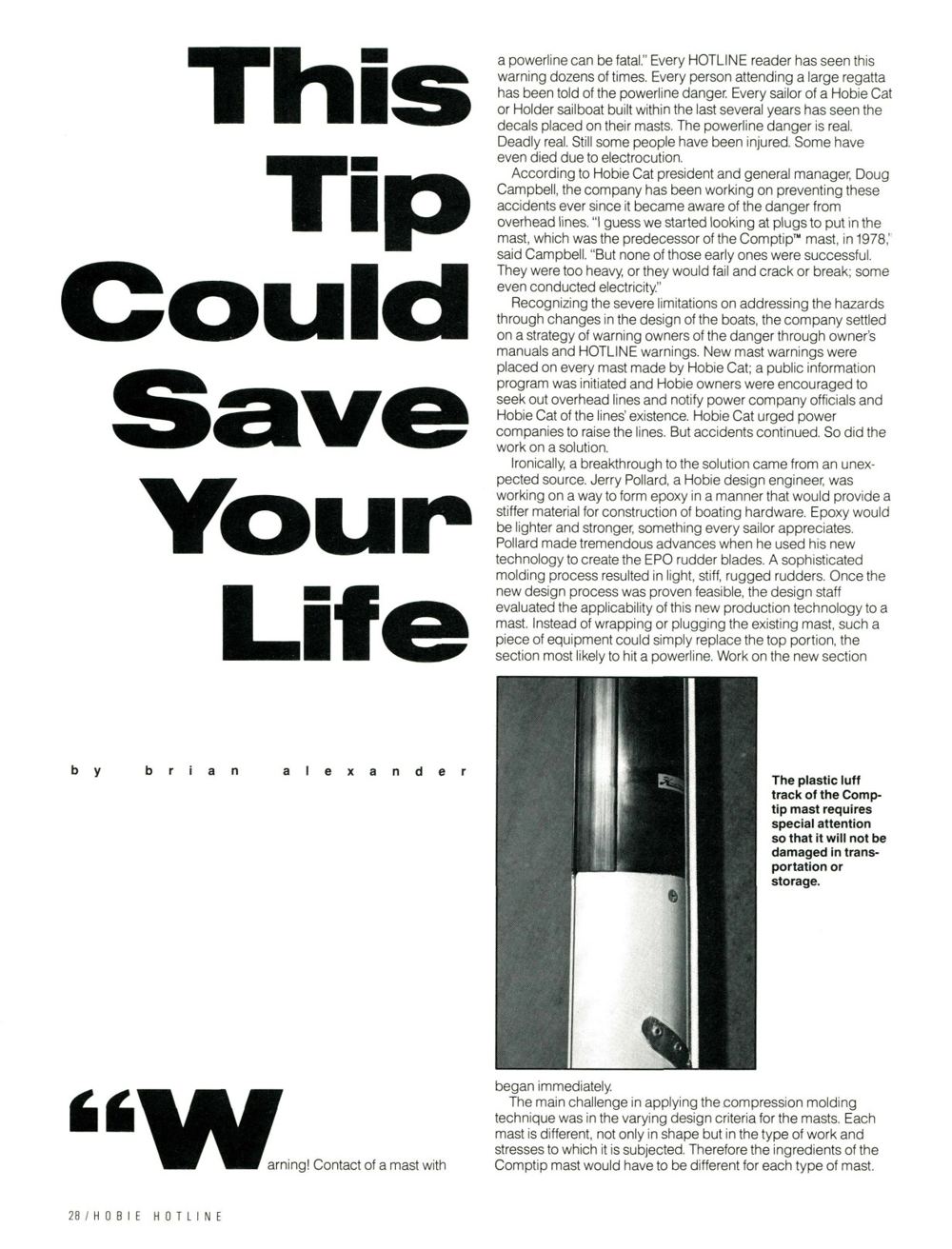
The Hotline's launch feature in January 1986 is the only account of the Comptip's development ever published, and it is worth reading closely. Campbell said the company "started looking at plugs to put in the mast, which was the predecessor of the Comptip, in 1978. But none of those early ones were successful. They were too heavy, or they would fail and crack or break; some even conducted electricity." Insulating wraps and plugs for a 26-foot aluminum tube in salt water did not work, so the company fell back on warnings.5
The answer came sideways. Jerry Pollard, a Hobie design engineer, was developing a compression-molding process for epoxy to make stiffer hardware, and used it first on the EPO rudder blades: "A sophisticated molding process resulted in light, stiff, rugged rudders." Once that worked, "the design staff evaluated the applicability of this new production technology to a mast. Instead of wrapping or plugging the existing mast, such a piece of equipment could simply replace the top portion, the section most likely to hit a powerline."5 Each mast needed its own recipe, "not only in shape but in the type of work and stresses to which it is subjected," so the 16, as the biggest fleet, came first, after "a frustrating series of redesign." The Hobie 17, then in development, was designed around a tip from the start.
New Hobie 16s built from September 1, 1985 had the Comptip. The retrofit program for existing 16s was free: "Owners won't have to pay a thing. The materials are no charge and we'll reimburse the dealer for the labor." The 18 tip was promised for the second quarter of 1986, then the 14, then the Holder dinghies. Campbell put the all-up cost at about $100 per mast, on top of "literally hundreds of thousands of dollars" of development since 1976, "and that does not include tooling costs. But if we save one life it's worth it."5
He was careful about what it did and did not do. "The Comptip mast is in no way a 100 percent guarantee against danger. The only 100 percent guarantee is to not hit a powerline. We believe that the increased electrical resistance of a clean and dry Comptip mast far, far outweighs any disadvantage." Clean and dry is the operative phrase, and Hobie's winter-maintenance columns repeated it for years: wash the tip with soap and water, never solvents, "to ensure that it minimizes the dangers of mast contact with overhead power lines." The main halyard was changed to line with an insulated section where it passes the tip.5 The performance trade-off was admitted too: the tip "is a little bendier than an all-aluminum mast," said Hobie 14 champion John Wake, "but that didn't seem to make any difference."6
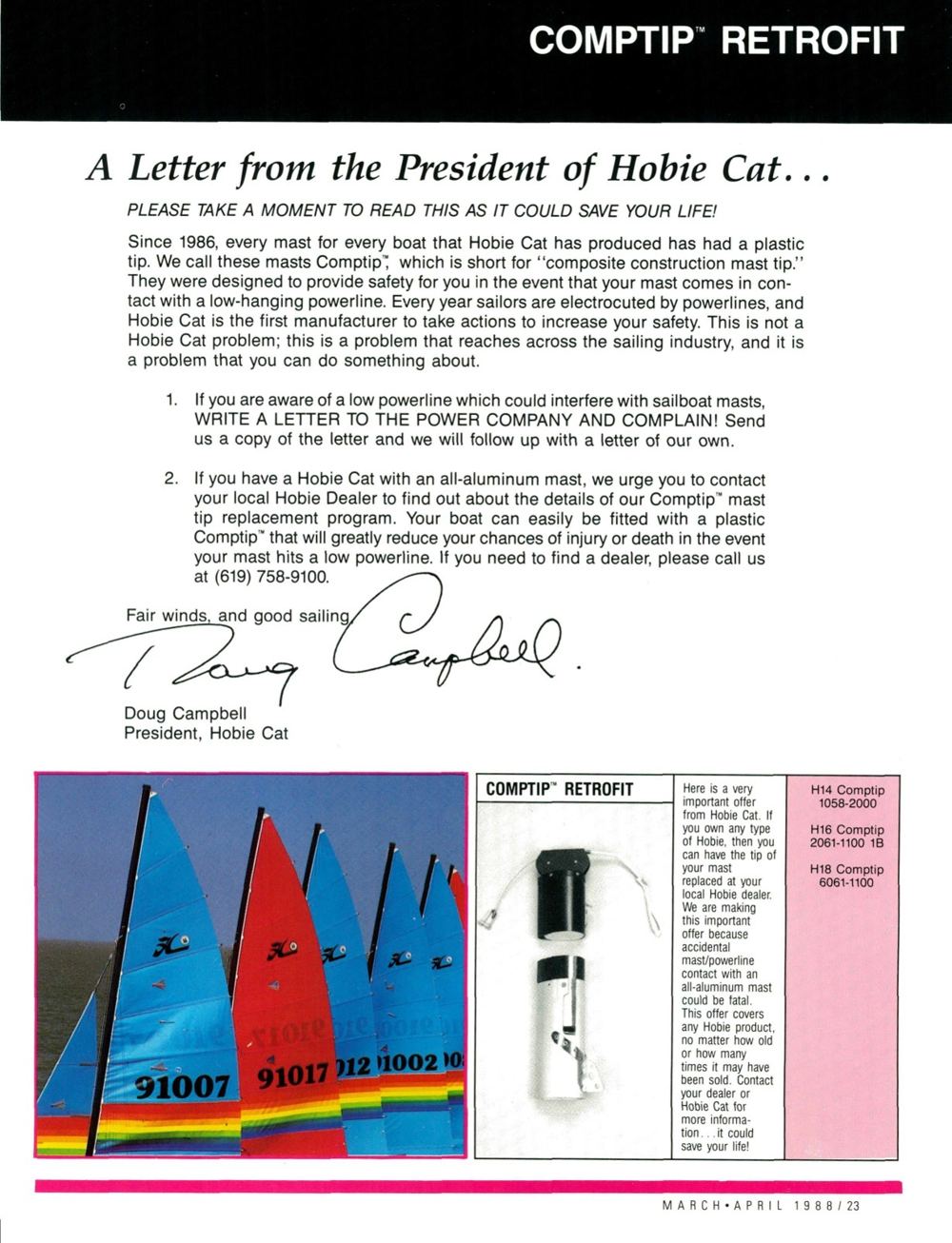
By March 1988 Campbell could write that "since 1986, every mast for every boat that Hobie Cat has produced has had a plastic tip," and extend the free retrofit to "any Hobie product, no matter how old or how many times it may have been sold." The retrofit kits were part 1058-2000 for the 14, 2061-1100 for the 16 and 6061-1100 for the 18.10
The controversy
Racers hated it, and they wrote in. "Thanks, But No Thanks to Comptip," one letter was headed in January 1987; the writer appreciated the free offer and declined it, since a line that "sliced through the forestay" of a friend's boat would not have been stopped by a tip.9 A Hobie 18 sailor dismissed "questionable 'high tech' improvements such as Mylar sails... and the ludicrous Comptip mast," and told the magazine that "buckling under to the threat of lawsuits does not promote seamanlike responsibility for one's actions."9 After nine of twelve boats dismasted in a storm during the Hog's Breath 1000 distance race, a reader asked whether they had broken "at the joint between the aluminum bottom and the tip," and whether that proved the tip was a built-in weakness.8 The World Hobie Class Association ruled in 1987 that it did "not foresee Comptip masts being mandatory worldwide on all models," because some overseas licensees could not make them.9
Hobie kept pushing. The January 1990 issue ran a feature called "The COMPTIP Controversy" and an editorial comparing it to seat belts: "Just as the seat belt issue was a major controversy, so has become the COMPTIP. And as seat belts became mandatory, so has the COMPTIP, for Hobie Cat racers." The feature told objectors: "It saddens us at Hobie to lose you as a subscriber and participant, but it would sadden us more to lose you altogether because of what we think are your misguided notions on the COMPTIP."12 In October 1990 the USYRU gave Hobie a special award for the program, and American Sailor magazine noted that ten to fifteen people a year were killed or seriously injured in power-line accidents, mostly on small boats launched from "non-traditional areas" where lines "may be hidden or unmarked."13 In 1992 the North American class rules settled it: "13.4 A COMPTIP shall be mandatory for the North American Region. All sailors will be allowed one exemption to this rule."14
It never fully settled. In 2008 a Hobie 16 owner combining two boats asked the forum which mast to keep and got both sides in full voice: "Comptips are for lawyers, not sailors" against "you won't get electrocuted with a comp-tip. I think that's a pretty nice perk." The most useful reply came from srm, a Hobie 18 owner since 1985, who listed everything that had worn out on his boat in 23 years, "at least 3 sets of sails, one trampoline, a couple hot sticks, a rudder blade, shrouds, oxen blocks, two front crossbars, lower rudder castings," and ended: "Comptip? Nope, same one's been on there since the retrofit in '88 or '89."30 In January 2026 a Florida club looking for a Getaway tip was still being told by a 1990s 18 racer that "Hobie went to composite tips merely to subdue all the ambulance-chasers."34
What it actually is
Despite the name and the price, there is nothing exotic in it. "It is just fiberglass using vinylester (polyester) resin," Matt Miller told an owner in 2012. "You can do repairs using similar material or epoxies."17 Five years later, asked about UV: "It is not carbon... just polyester and black pigment."19 The black is the UV barrier, the same trick used on the EPO rudders.30 The tip is compression molded, foam filled, and has a snap-on plastic luff track; later boats got a short aluminum track section at the head so the sail's headboard cannot pull out.26 The halyard hook at the top rivets through a cast aluminum insert inside the tip.29
The joint is the whole story. The tip has a plug that slides about eight inches into the aluminum extrusion (8.5 inches on the 21, per an owner who measured it), bonded with epoxy or polyester putty and, on second-generation tips, also pinned by the rivets of the shroud tang.16, 19 Below the plug, inside the aluminum, sits a foam plug against an aluminum plate that seals the lower mast; the factory bedded it in Sikaflex.11 Hobie's own retrofit sheet shows the sequence: cut the extrusion square at the specified length, drill a 3/8-inch hole nine inches below the cut, push an Ethafoam plug twelve inches down, file the tip for a snug fit, putty the inside of the extrusion six inches deep, ram the tip home "in a battering ram motion" with the mast base against a padded post, hold everything square while it cures, then inject two-part urethane foam through the hole.15
Tips are not interchangeable. "Hobie 16 and Hobie 18 Comptips are very different. A 16 Comptip is straight. An 18 Comptip is tapered," wrote Matt Bounds, the forum's other long-serving expert. The first-generation tips of 1985-86 could be installed without removing the mast tang and "have a bad habit of working loose," which is why the second generation uses the tang rivets.25 The 17's tip was held by both glue and the tang, with an early single-bolt tang on the first boats.33 The two Hobie 21 tips (part 30581051 for the SE, 36581051 for the SC) fit the same extrusion but have different heads for different halyard systems; Miller thought a swap "could work" if the halyard gear was changed too.20 The 21 is the heaviest of them all: 5 mm wall at the base against a 2.5 mm extrusion, a 15-inch circumference at the joint, and 98.5 inches long on the SE.19
| Model | Tip | Part number | Retrofit cut length | Status |
|---|---|---|---|---|
| Hobie 14 | straight | 1058-2000 (retrofit kit) | 15' 1 1/8" | check with dealer |
| Hobie 16 | straight | 2061-1100 (retrofit kit) | 18' 3 3/4" | in production |
| Hobie 17 | own profile | see parts guide | factory only | discontinued |
| Hobie 18 / SX | tapered | 6061-1100 (retrofit kit) | 20' 5 3/8" | discontinued |
| Hobie 21 SE | heavy, tapered | 30581051 | factory only | last sold 2014, tooling failed |
| Hobie 21 SC | heavy, tapered | 36581051 | factory only | discontinued by 2017 |
| Wave, Getaway, T2 | Wave profile | see parts guide | factory only | in production, periodically out of stock |
Part numbers from the 1988 retrofit offer and the 2017 forum thread; cut lengths from the retrofit sheet. The HR14 (Holder) cut was 14' 4 3/8".10, 15, 20
How it fails
Cracks at the joint. Almost every tip develops a ring of cracks in the black surface where it meets the aluminum, and a 2018 Getaway owner was told by his dealer "it was normal for some cracking to occur at the joint."16 A 2023 TheBeachcats thread and a 2026 forum reply agree the outer skin is a layer of resin that crazes cosmetically. The test is load, not looks: step the mast, hook the mainsheet to the main halyard to simulate sailing loads, lay the boat on its side, and have one person tension and release the sheet "while another watches and listens to the comptip as it flexes to see if those cracks open up or make any unpleasant sounds."31 A simpler version: grab the mast float and twist. One owner did and "the whole crack opens up," which is structural.24
A loose joint. This is the root of most chipping. Miller: "It is important for the CompTip to be glued in. Being loose is what caused the chipping, but at some point it may be worse as the boat wears. There is a lot of downward loads grinding the two sections together while sailing."16 Previous owners often re-seat a loose tip with silicone, which does nothing structural and has to be scraped out later.
Water. The joint is a seam, and the tip adds "a potential for leaking." Water in the lower mast usually means the foam plug has shrunk or detached, or a tang rivet is weeping, rather than the tip bond itself. Diagnose by pressurizing the mast with a shop vac on blow and spraying soapy water, remembering that bubbles at the luff track are normal for a while.11, 27 A gallon of water collected over one Tennessee winter from condensation alone. Freezing water can split an extrusion.
Hardware working loose. The halyard hook rivets pull out of the composite if they were popped short; the luff track cracks if the sail is left half-dropped and flogging; the track groove on the tip itself is fragile and "cracked off like peanut brittle" for one owner who pried the old track off cold.26, 28, 29
Sun. Owners disagree. A Florida owner who stores mast-up says "the sun eats comptips up"; Miller said UV had not "caused any significant issues with these over the years," and an owner whose 1986 tip had been left outside by previous owners saw no deterioration.19, 30 A cover is cheap insurance and dealers sold them from 1986.
Catastrophic failure. It happens, rarely, and apparently without warning. In August 2017 a 21 Sport Cruiser's tip "suddenly... fell off" on Lake Charlevoix in light air. The owner, an engineer, measured the fracture and concluded the crack had started on the tension side of the mast, "right at the interface between the aluminum and the comp tip," after 25 years of use and no known impact. Miller's reaction: "The CompTip had to have some damage at some point. Those things are bullet proof. Thick." The owner's own verdict is the honest one: "With composites it can be really tough to tell if there is damage... If you find a way to determine if your mast is OK, I bet there are some folks at Boeing that would love to talk to you."19
Repairs, from easiest to hardest
Cosmetic cracks at the base
Miller's answer in 2013, in full: "Automotive BONDO and black spray paint."33 Sand, fill, sand, paint. One owner found Rustoleum bubbled over fresh Bondo; wait longer and use a primer. Bondo is a cosmetic filler here, not a structural one; the Getaway owner who tried it as a crack filler in 2019 reported "it didn't hold up... since it doesn't flex."16
Removing a tip
Needed for a re-bond, a leak fix below the plug, or a replacement. The method is the same on every model and Hobie never published it, which annoyed the owners who worked it out.22
- Remove the mast tang. Do not wallow the rivets out with a drill: start each with a cobalt bit the size of the rivet, then use that dimple to seat a pin punch and drive the rivet through, so the hole stays round and the original-size rivet will grip again. Check whether your rivets have caps.19
- Support the mast on sawhorses and put the whole thing under tension: base lashed to a truck hitch or tree, tip end to a come-along or a 6:1 mainsheet system. Hitch the tip with a couple of round turns around the mast at the sail-track cutout. "Don't put any stress on the halyard cleats. You'll rip them off and leave the rivets behind."18
- Heat the aluminum, not the tip. One propane torch each side, moving constantly, over the top eight inches. About 140 F softens most epoxy; the Hobie 21 owners needed 10 to 15 minutes with two torches, and twenty feet of aluminum "makes a dandy heat sink."18, 22
- When you smell the resin, wiggle and pull. A rubber mallet on the aluminum, a slide hammer with Vise-Grips on the stub, or re-tensioning the come-along all work. Once it moves an inch or two it comes out by hand.18, 19
- If a previous owner's rivets were drilled ragged they leave little hooks in the plug; expect to fight those. Video of the last few seconds on a 21SE is in the removal thread.22
Re-bonding a tip
Miller's procedure, posted in 2018, is the closest thing to a factory method and reads like the retrofit sheet with the lessons added:16
"Mix a batch of the Bondo to test the cure time. The catalyst will make the grey putty lightly pink to more red if you add more. You can see by color if it is over catalyzed. As I recall... very light pink tint at most. Less is better to a point. Just takes longer to cure. Over catalyzed putty ends up like hard rubber. Correctly catalyzed ends up as hard as rock. Do it in shade or cooler weather. Tape the aluminum and the comptip to prevent overflow from getting on it. Tape the tracks on both to keep putty from getting in them. Get the mast up on some saw horses. Base against a tree or post you can bang it against. Putty a thin layer on the base and some inside the aluminum extrusion. You will hold the comptip and insert as far as it will go... pull the whole assembly away from the tree/post and then (holding the CompTip) like a battering ram... hit the base of the mast against the tree. The inertia of the quick stop against the tree forces the comptip in. Repeat until the CompTip is in. Check alignment left right and sight along the track to check fore and aft alignment. Hold somehow with track up to cure."Matt Miller, Hobie Cat USA, September 2018
The thread that prompted it is the cautionary tale. A Spanish Getaway owner re-bonded with fiber-reinforced polyester filler, found the aluminum socket was 1.2 cm deeper than the plug so the tip's weight rested on the extrusion edge, and had the joint fail twice, the second time over a winter. He re-did it with epoxy, this time leaving a gap of about a centimeter between tip and aluminum "to allow the comptip to flex without damage," sealed with Sikaflex.16 An Australian owner used Hobie's own two-part epoxy kit (about $40 there), pulled the halves together overnight with the mainsheet blocks, left a 3 mm gap and faired it with Sikaflex; "has stayed firm for over a year."16 On an 18, "when you re-install it, you should use epoxy in addition to whichever mechanical fasteners were originally used," with both mating surfaces thoroughly cleaned first.33 Scrape every trace of old silicone out of the extrusion before you start; it was the first owner's main job.
The consensus across the threads: epoxy or thickened epoxy for the bond, polyester filler only for cosmetics, a small expansion gap, the tang rivets reinstalled, and the mast held dead straight with the track up until cured.
A cracked top
The thin section around the halyard hook cracks when a mast float is twisted, a masthead is pried out, or the boat blows over on the beach. srm's 2012 repair on a Hobie 18 is the model. Remove the masthead, sand and acetone-wipe the top four inches inside and out and do not touch them again with bare hands. Inside: two layers of 6 oz carbon tape with a layer of fiberglass between the carbon and the aluminum head casting to stop galvanic corrosion, wet out on cardboard and placed with a brush. Outside: three layers of 6 oz carbon, masked off from the luff track, then wrapped tight in electrical tape to squeeze out excess resin "much like vacuum bagging." Finally, resin-soaked glass roving wrapped around the very tip for hoop strength so the end cannot spread, and an overcoat of epoxy. "Figure out how you're going to do everything BEFORE you start mixing resin. Do dry runs with paper templates or dry cloth."17 A balloon inflated inside the tip does the same job as the tape on the inner patch.17 For a crack running down from a rivet hole, drill out the rivets so adhesive can reach both faces, and drill a 1/8-inch hole at the very end of the crack to stop it running, an aircraft-window trick.24
Halyard hook rivets
If the hook pulls out, the holes have usually enlarged. Miller: "Use 1/4 inch rivets. The tip is fine." Or drill new holes a few inches away, keeping the hook in the same relative position, fill the old ones with epoxy or sealer, and use all four.29
Luff track
The plastic track replaces independently of the tip and the technique is the same on every model after the 16 (see Hobie's sheet 38584001 in the library). Soften the old track with a heat gun before prying, or you will break the groove; lubricate the new one with soapy water and slide it on from the bottom of the tip, starting on the repaired side if there is one.26, 28 Later boats carry a short aluminum track at the head; if your headboard pulls out of a full-length plastic track, retrofit the aluminum piece, "less than an hour."26 A broken groove is "only putty, no glass fiber": one owner reassembled the pieces with fast epoxy, filled with epoxy and microballoons, sanded to profile, and the new track snapped on. File the track flush at the aluminum joint and chamfer its lower end so the bolt rope does not bind.28
Leaks
Hobie's 1988 "Ask the Expert" column on a leaking 16 is still the procedure: remove the two flat-head bolts at the top of the extrusion (the tang can stay), heat the top eight inches slowly, pull the tip, clean everything, and patch the foam plug and plate with Sikaflex or 3M 5200, replacing them if needed. Silicone "may be used to seal the leaks, but does not work as well."11 The factory now foams the joint with two-part flotation foam, which is what the retrofit sheet specifies.15, 27 If water only drips at the joint with no accumulation below, leave it alone. A 1/8-inch drain hole near the mast base, plugged when sailing, is the pragmatic fix several owners use.
When you cannot buy one
For the 16, Wave and Getaway, tips are still made, though a Florida club found Getaway tips out of stock across dealers in January 2026 and was pointed at dealer back-stock and donor boats.34 For the 14, 17 and 18, check Hobie's parts search and dealers before assuming the worst; the 18's tapered tip was still "relatively cheap and easy to replace" in 2008.30
For the Hobie 21 the record is unambiguous. In October 2013 Miller quoted a new 21SE tip at $960: "We still list the CompTip for the 21SE, so should be able to get one made here."21 In 2017: "the 21SC CompTip is no longer available," and for the SE, "discontinued product from the mid-late 90's now 20 years old. At some point the tooling fails as is the case here. Last one sold in 2014." Asked for the mold: "The tooling is not usable."19, 20 The 21's extrusion is unique as well: "VERY stout. The original mast was 33 feet tall. The larger section is important due to the weight of the boat."23 Here is what owners have done.
- Find a used one. Broken masts with good tips turn up on the 21 board every year or two, and one 21SE owner in Las Vegas offered a sound spare in 2019, 2021 and 2023.21, 23, 33 The Facebook 21SE group is where the only complete mast anyone has seen for sale appeared.21
- Convert a Hobie 18 mast. This is the one documented success. After his 21SC tip broke, Joe in Michigan fitted a Hobie 18 mast: a custom extra-tall mast base in epoxy, glass and aluminum made up the length, the shrouds needed 6 inches of extension (shroud extenders, not Hyfield levers, which lack travel), an Aussie ring replaced the stretchy halyard, and the 21SC sails fit. It is light enough to step without the gin pole, has no plastic track to jam, and "the top doesn't break off without warning." He would not take it four-up with two on trapeze, and Miller noted the 18 "is a much smaller section." Three years on it had not broken.19, 23 Another owner points out the 21SE mast ball matches the Getaway and Miracle 20, so a Miracle 20 mast may be the closer donor.19
- Sleeve and extend the aluminum. Miller's first suggestion for the broken 21SC was "you could sleeve it and make it work." Find a matching section, sleeve the joint low down, and accept an all-aluminum mast that bends differently. Aquarius Sail's ARC extrusions have been mentioned as candidates: ARC-17 is 28' 9" against the 21SC's 29', and ARC-21 is 33' like the 21SE.19, 23
- Have a spar maker replicate it. Miller's own recommendation in 2021: "It may be better to work with a spar manufacturer to replicate the entire length." He also posted the factory drawings of the 21SC complete mast assembly and the 18 extrusion, both now in this site's library; one owner priced a full replacement at about $5,000 plus shipping.19, 23
- Mold your own. The tip was patented around 1986, so the patent expired around 2006. Nobody has sold one since, for one reason: "The liability is simply too much to gamble on." The Las Vegas owner designed a layup of S2 glass with unidirectional and woven cloth, Kevlar uni, a Nomex honeycomb core and epoxy, claimed 30 percent lighter and twice as strong, and chose glass over carbon because "it doesn't conduct electricity as much." He planned a plaster-face mold taken from his good tip, a longer splice than the stock 8.5 inches, and a removable fit. In 2023 he gave up on selling them.19, 23, 33 Another owner asked Hobie for a print of the 21SE tip and the masthead insert in 2023 and got one by email, so the drawings exist.32 If you have them, this site will host them.
- Go all-aluminum. Several racers advise finding an old one-piece mast and skipping the tip. It is lighter, stiffer, has no plastic track and no joint. It is also illegal for North American class racing, and it removes the one thing that has been shown to reduce electrocutions. Nobody in these threads who did it pretended otherwise; the standard caveat is "just WATCH FOR OVERHEAD LINES."30, 34
The measured mast section, the mast drawings and the owner-made masthead fitting on the Hobie 21 mast page and the 3D-printed parts page are this site's contribution to the problem. If you have molded, printed or machined a replacement tip, or have the factory print, the About page says how to add it.