In October 2026 a man in Hermantown, Minnesota, offered the hulls and crossbars of a 1978 Hobie 18 for nothing, delivery for a small fee, the trailer for $150 if you wanted it. The same week a couple in Fair Oaks, California, listed a two-owner 1979 Hobie 16, all original, on a trailer with a storage box, for $300 or best offer; it had last sailed in 2016. In Corona a man had two 16s and a trailer for $500, one hull soft. In Leesburg, Virginia, a complete 16 with a dry-rotted trampoline and no trailer was $650.17
These boats are the entry ticket to the sport for a great many people, and the question they raise is always the same. In February 2026 it was asked on TheBeachcats in its usual form: a 16 with a trailer, no sails, painted hulls, $750, a total budget of $2,000, "worth it as a project boat?"1 The answers that thread got, and twenty years of answers before it, are consistent enough to write down. This article does the sums with real numbers: parts prices read from the catalogs this month, and used prices from the ads this archive tracked between September and October 2026.917
The free boat
A free Hobie is almost never a free sailing Hobie. It is free because the owner has already removed, sold or lost the parts that are worth money, or because what remains needs more than they are willing to put in. The Hermantown 18 is honest about this: hulls and crossbars, both bottoms needing repair, nothing else. A Houston seller the same month showed the other side of the transaction. His 16 had breached a hull, so he was parting it out: trampoline $250, mast and boom $500, rigging with trapeze $150, rudders and tillers $150, sails $500, or $1,000 for the lot.17 That is what a dead Hobie 16 is worth in pieces, and it is why the hulls turn up bare. Everything that unbolts has been sold to someone who already owns a boat.
Jerome Vaughan, posting as Rattlenhum, put the same point the other way round about the $750 boat: "This boat's rudder system, mast, and trailer alone are worth $1,000 easy on the used market."1 The parts have a price. The hulls, unless they are late, dry and stiff, have almost none. Which Hobie Is This on this site has the inspection checklist for deciding which kind of hulls you are looking at, and Soft Decks explains what is wrong with the other kind.
What you get, and what you do not
A Hobie 16 that sails has, besides the hulls, a front and rear crossbar with the mast step and traveler track; a mast of about 26 feet with a Comptip on anything built since 1986; a boom; a mainsail with eight battens; a jib with battens; two shrouds, a forestay, an upper forestay, two bridle wires, two trapeze wires; a main halyard, a jib halyard, a mainsheet system with its blocks, a jib sheet and traveler cars, a downhaul, an outhaul; a trampoline with its lacing; two rudder blades in two sets of castings with cams, two tiller arms, a tiller crossbar and an extension; a righting line; and, if you intend to move it, a trailer with a title, or beach wheels and a yard by the water. A free boat comes with a random subset of this list, and a $300 boat comes with all of it in a condition you cannot assess until you have spent a Saturday with it.
The checklist in the identification article warns that completeness is where cheap boats get expensive: goosenecks, cleats, jib cars, tiller extensions, trapeze gear and righting lines add up fast. The February thread's poster had done part of the sum. To the $750 he added a used mainsail at $250, a batten set at $380, a jib at $250 and a line kit at $230, which took him to about $1,900 before standing rigging, which everyone in the thread told him was a safety item, and before anything went wrong.1
The bill, part by part
The table prices a Hobie 16 three ways. "Used" is what people were asking for the part in classified ads this month, so it is what you would pay if the right ad appeared when you needed it. "New, aftermarket" is Murrays, SLO Sail and Canvas and the other small makers. "New, Hobie" is the factory part through a dealer, where one is still made. All new prices were read from the retailers' pages in October 2026 and will drift; the used ones are asking prices, not sales.910121314151617
| Hobie 16 part | Used, this month | New, aftermarket | New, Hobie |
|---|---|---|---|
| Mainsail | $250 to $500 as part of a lot | $875 to $950 Dacron (Murrays) | $1,448 white, $1,540 color |
| Jib | usually sold with the main | $350 to $420 | $597 white, $666 color |
| Main batten set | $250 (an 18 set) | $279 | $379 |
| Trampoline | $250 used; $420 new in box | $450 to $495 mesh | $655 mesh |
| Standing rigging, all wires | never buy used | $350 kit, 1995 spec | by the piece |
| Mast | $100 to $500 | none | $2,541 with Comptip; tip alone $1,011 |
| Boom | $45 | none | $643 |
| Rudder blades, pair | $150 with tillers and castings | none in production | $1,138 (EPO-3, $569 each, backordered) |
| Mainsheet system | rarely offered alone | $400 to $435 Harken 6:1 | same blocks |
| Running rigging, all lines | no | about $230 as a kit | |
| Mast float | sometimes with a boat | $203 Baby Bob, $367 Mama Bob | same, both out of stock |
| Beach wheels | $400 | $619 Cat Trax, cradles extra | |
| Trailer | $150 to $800 | new aluminum trailers cost more than most of the boats in this article | |
Three things stand out. First, a new Hobie mainsail and jib together cost more than the median used Hobie 16 on the market this month, trailer included. Second, the mast and the rudders are the parts to make sure you get with any cheap boat, because the factory prices for them are absurd against the value of the boat and there is no aftermarket: a pair of EPO-3 blades is $1,138 and the backorder queue is long.13 Third, the standing rigging is the one thing you should not economize on and cannot inspect. Murrays' 1995-spec kit at $350 is the single best-value line on the page, and it is on every path below.12
For the Hobie 18 the numbers are worse, because the boat is out of production and the parts are following it. In October 2026 Murrays listed the white 18 mainsail at $1,429 as "discontinued, limited availability," the mast assembly at $2,345 and sold out, the Comptip at $939 and sold out, the boom at $655 and sold out, the batten set sold out; the 18 rigging kit is $650 and the trampoline $495.11 A used 18 mast was $200 in Loxahatchee this month and the daggerboards $150; the Hermantown hulls would need both, and then sails.17 The 17, the 20 and the 21 are further along the same road.
Three paths to the same beach
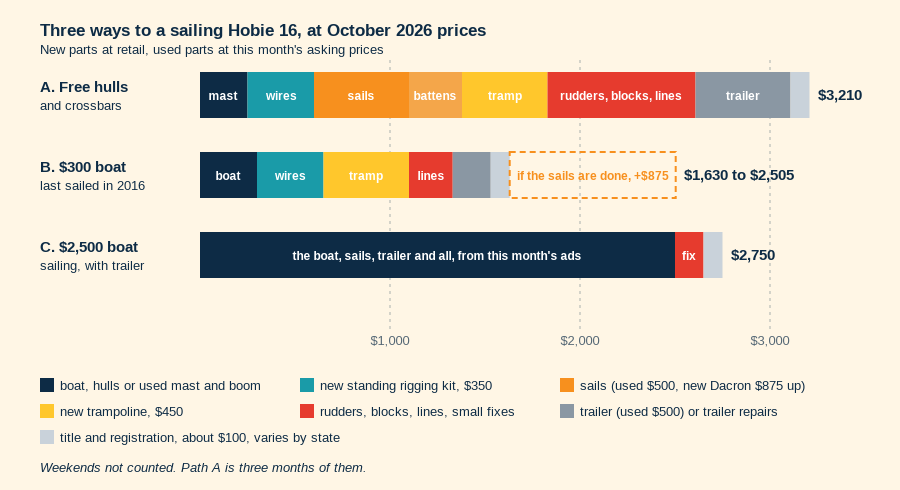
Path A, the free hulls. Take the Hermantown offer as if it were a 16, and buy every missing part at the cheapest sane price: a used mast and boom for $250, the $350 rigging kit, a used main and jib for $500, a batten set for $280, a new trampoline for $450, used rudders with castings for $150, a mainsheet system and lines for $630, a used trailer for $500, and a title and registration for $100 in a typical state. That is $3,210 before the hull repair that made the boat free, before gelcoat, and before the three months of weekends it takes to find the used parts at those prices.91017 Cat Scratch, pricing the $750 boat's cosmetics, estimated $400 to $500 for gelcoat supplies and tools alone, and advised long-boarding by hand because a power sander leaves a wavy finish.1
Path B, the $300 boat. The Fair Oaks 16 is complete and original. Original on a 1979 boat means 47-year-old wire, so the $350 kit goes on before it sails. The trampoline will be done, $450. The lines will be stiff, $230. The trailer has sat under a tree for 14 years: tires, bearings and lights, $200. Registration, $100. That is $1,630 for a boat with Cat Fever sails that may or may not have another season in them; if they do not, add $875 for a Dacron main and you are at $2,505.179 And you do not yet know about the decks. The Fair Oaks sellers say the boat spent its first 33 years indoors, which is the best thing you can hear; press every square foot anyway.
Path C, the $2,500 boat. In Fort Lauderdale this month a 2006 Hobie 16 with a trailer and extras was $2,500; in Louisville a 16 with two mains, a new trampoline, new lines, new rudder cams, a motor mount, a titled trailer on new tires and "many extras from decades of sailing Hobie 16's" was $2,750; in Springfield, Virginia, a 1983 on a titled LoadRite was $2,200.17 Add a registration and a weekend of small fixes and you are sailing for $2,750. Rattlenhum's advice to the February poster was exactly this: wait, and buy a turnkey 16 for around $2,000.1 jonathan162's was blunter: the price was high for a boat without sails, and the poster should expect to spend another thousand.1
The lesson of the diagram is not that free boats are a trap. It is that the price of a used Hobie is almost entirely the price of its parts, so a complete boat at $2,500 and a free boat plus $3,000 of parts are the same purchase, and the complete one comes assembled, tested and with a title. The seller of a good boat has already paid for your standing rigging and your trampoline and is charging you less than they cost.
The costs that are not on the invoice
The hulls. A soft deck can be injected and a cracked keel can be glassed, and the materials are cheap: a quart of epoxy, syringes, filler, a sanding board. The labor is not cheap if your weekends are worth anything, and the outcome is not certain. Soft Decks on this site covers the diagnosis and the repair and, more usefully for a buyer, when a hull is beyond it. Painted hulls hide all of this, which is why dogboy said he would not buy a painted boat at all.1
The wire. Standing rigging fails without warning, usually at a swage, usually when the boat is loaded, and a mast coming down is the most dangerous thing a Hobie does short of hitting a power line. No one in any of these threads prices used wire, because no one should buy it. Budget the kit on any boat whose seller cannot say when the wires were replaced, and note that the February thread treated trapeze wires as part of the same rule.1
The trailer. In 2002 a trailer for a 16 was "about $800 to fabricate or buy from a dealer."3 Today a used galvanized trailer under a Hobie is anywhere from the Hermantown $150 to about $800, and a new aluminum one is a four-figure item plus freight that makes most of the boats in this article look free. A trailer that has sat needs bearings, tires and lights before the first trip, and Rattlenhum's habit of feeling the hubs for heat at the first stop is worth copying.1 Note that a trailer without paperwork can be harder to register than the boat.
The title. This varies by state and catches people every year. In 2015 a Florida buyer took a 1975 Hobie 16 he had bought on a bill of sale to the tax office to register the trailer and was told the boat needed a title and registration too. The thread that followed turned up a 30-year owner who had never registered boat or trailer, and the state's rule: a vessel of 16 feet or more must be titled and registered, motor or not, and a Hobie 16 is 16 feet 7 inches.4 Before money changes hands, find out what your state wants for a boat whose seller has no title, because "bonded title" and "abandoned vessel" processes take months and in some states are not available for a boat that was never registered there.
The time. A free boat is a scavenger hunt, as texastuma warned the February poster.1 Used masts, rudders and sails at the prices in the table exist, but not on the day you need them and not in your town. If the point is to sail this summer, that matters more than the money.
What boats actually sell for
Hobie publishes no list price for the 16, but dealers listing new 2025 boats on Boats.com in 2026 were asking between $14,400 and $16,900.19 Below that the market is wide and surprisingly flat. These are asking prices from ads this archive found between 10 September and 20 October 2026, with the trailer noted where the ad included one.17
| Boat | Where | Asking |
|---|---|---|
| 1979 Hobie 16, original, last sailed 2016, trailer | Fair Oaks CA | $300 |
| Hobie 16 and trailer, two sails, bags | Portland OR | $600 |
| Hobie 16, no trailer, tired trampoline | Leesburg VA | $650 |
| Hobie 18 project with trailer | Stoneham MA | $650 |
| Early-1970s Hobie 16, trailer with box | Toronto ON | $750 |
| 1979 Hobie 16, two sets of sails | Clearlake CA | $799 |
| 1976 Hobie 16, new trampoline | Boise ID | $1,200 |
| 1982 Hobie 16, Carumba sails, EZ-Loader trailer | Minneapolis MN | $1,200 |
| 1981 Hobie 16, graphite rudders, new trampoline, trailer | Los Gatos CA | $1,500 |
| 1980 Hobie 16, new mainsail, trailer | Littleton CO | $1,950 |
| 1983 Hobie 16, titled trailer | Springfield VA | $2,200 |
| 1985 Hobie 18, 1992 sails, trailer | Parker CO | $2,250 |
| 2006 Hobie 16, trailer, extras | Fort Lauderdale FL | $2,500 |
| Hobie 16, two mains, new trampoline, motor mount, titled trailer | Louisville KY | $2,750 |
| Hobie 16, race rigged, spinnaker, Cat Trax | Fort Walton Beach FL | $3,700 |
| 1995 Hobie 20, race ready | Bass Lake CA | $4,500 |
| 2015 Hobie 16, garage kept, trailer, three harnesses | Apex NC | $8,000 |
| New 2025 Hobie 16 at a dealer | $14,400 to $16,900 |
The shape of the list is the shape it has had for decades. Boats from the 1970s and early 1980s sit between $300 and $1,500 regardless of year, and what moves one up the list is not its age but what has been replaced on it: the Littleton boat is a 1980 with a new mainsail at $1,950, the Los Gatos boat a 1981 with new rudders and trampoline at $1,500, the Boise boat a 1976 with a new trampoline at $1,200. Above $2,000 you are paying for a late boat or a complete refit, and above $4,000 for a boat under about fifteen years old. The Bravo is the outlier at the bottom: a sailing Bravo in St. Petersburg was $550 this month, less than a 16 trampoline.17
In April 2003 hobie1knobi posted a table of used Hobie 16 values, complete with trailer and gear, from the January figures that year: 1970 to 1976 boats at $500 to $800; 1984 to 1988 at $800 to $1,300; 1989 to 1993 at $1,200 to $1,999; 1994 to 1999 above $1,800 but under $4,000; 2000 and later above $2,000 but under $5,000. A new 16 then listed at $7,795 without a trailer.2 Compare the two lists and the point makes itself. Twenty-three years later a 1970s Hobie 16 still asks $600 to $1,500 in the same dollars, while those dollars have lost about 40 percent of their value and the new boat has doubled.18 Old Hobies have not held their value; they have held their price, which is a different and worse thing for a seller and a very good thing for a buyer. The floor is the price of the parts, and the parts have not fallen.
1978 prices, and why parts never got cheaper
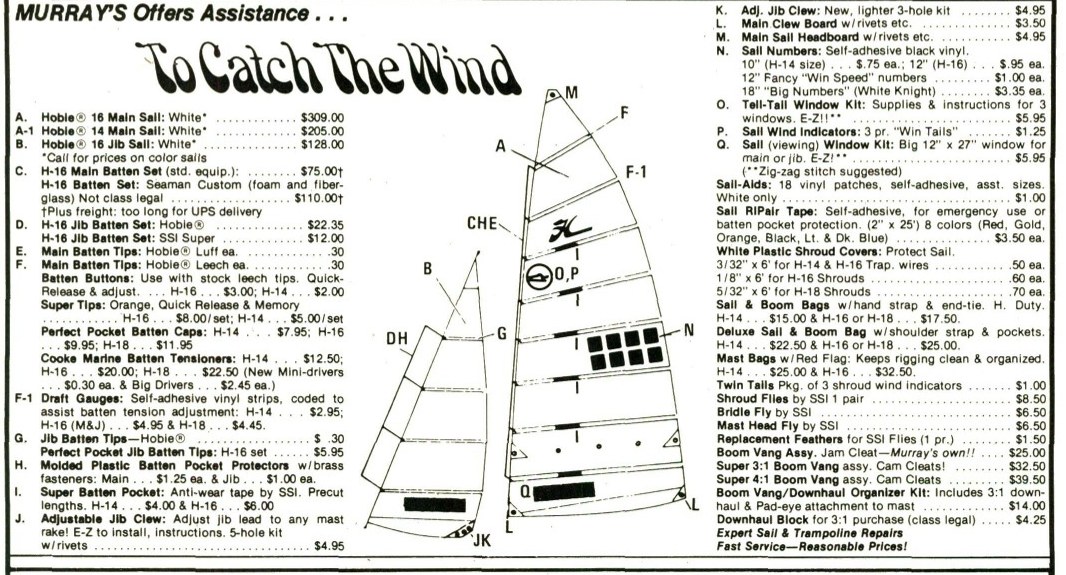
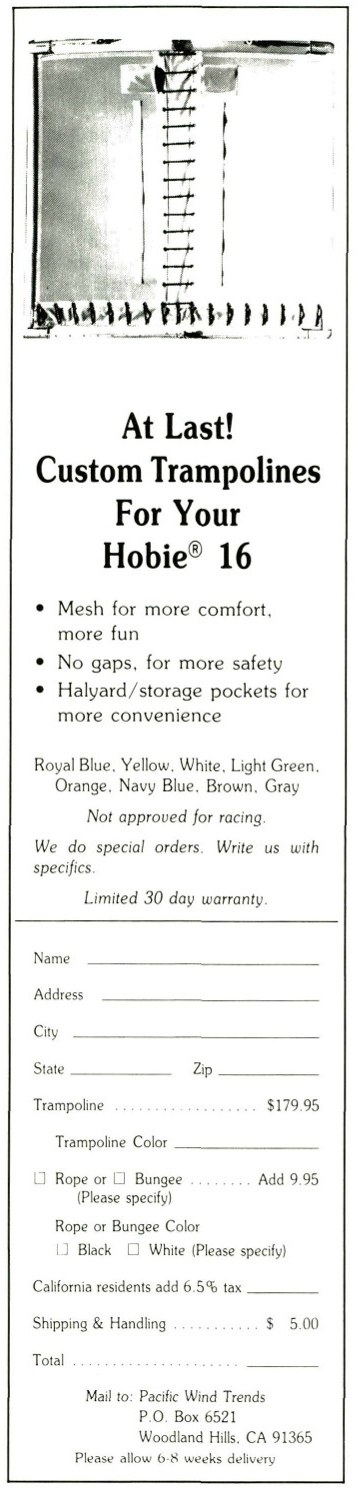
The Hotline's back pages were a parts catalog for twenty years, and they let us check the feeling that everything used to be cheaper. In June 1977 Murray's listed a white Hobie 16 mainsail at $288; by May 1978 it was $309, the jib $128 and the standard batten set $75.65 Run those through the Bureau of Labor Statistics calculator and the 1978 mainsail is about $1,500 in 2026 money, the jib about $640, the battens about $380.18 Hobie's prices this month are $1,448, $597 and $379.9 In real terms a Hobie 16 sail costs exactly what it cost when Jimmy Carter was president. A trampoline tells the same story: Pacific Wind Trends' mesh 16 trampoline, "at last," was $179.95 in July 1984, roughly $560 today, against $450 to $655 now.710 Only the blocks got cheaper. A Harken 8:1 mainsheet system listed at $110.30 in November 1974, about $700 today; a Harken 6:1 for the 16 is $400 to $435.810
This is the whole economics of the free Hobie in one paragraph. The boat depreciated to nothing because hundreds of thousands were built and the hull is just a shape in fiberglass. The parts did not depreciate at all, because each one is a small production run of a real object made by people, and the people have not got cheaper. So the ratio of parts to boat, which was small when the boat was new and the sails were a fraction of its price, is now one to one or worse. A used Hobie is a bundle of parts with a hull thrown in, and should be priced that way from either side of the sale.
When the free boat is the right boat
There are four cases, and they are all about parts.
- You already own one. If you sail a Hobie 18, the Hermantown hulls are two spare crossbars, four pylon castings, a set of shroud anchors, deck hardware and a trailer for $150, and that is worth the drive. Every fleet has a member with a dead boat in the side yard for this reason, and it is the rational reason.
- You have the expensive parts already. A mast, boom, sails and rudders from a wreck, an insurance write-off or a friend's garage turn Path A into a $1,500 project, and a free hull with a good deck is then exactly what you need. This is how most of the restored 1970s boats you see on the beach came to exist.
- The project is the point. Some people want to learn fiberglass, gelcoat and rigging on a boat that cannot be made worse, and will spend $3,000 and a winter doing it with their eyes open. Rattlenhum's counsel is the right one for them: spend nothing on cosmetics, "make it safe and sail it until it breaks, then upgrade if you're into it."1
- The cheap boat is actually complete and dry. Once in a while a $300 ad is a garage-kept boat whose owner simply wants it gone, like the Fair Oaks 16 may be. If the decks are hard, the mast is straight, the sails are crisp and the castings are the later kind, a $300 boat plus the $350 rigging kit is the best deal in sailing. The checklist exists to tell you whether you have found one of these, and the answer is usually no.
In every other case, the arithmetic says to pay $2,000 to $2,750 for someone else's finished project, inspect it the same way, and spend the saved weekends on the water. The seller who put a new trampoline and new wires on a 1981 boat and is asking $1,500 has given you $800 of parts and the labor for nothing; take it, and thank them.
The worksheet
Before saying yes to any Hobie under $1,000, price these lines for that boat, using the table above or the ads on this site, and add them up. If the total is more than the cost of the best complete boat within a day's drive, you have your answer.
- Hull repair: number and size of soft spots, cracks at the keels and pylons, state of the gelcoat; materials and your honest hours.
- Standing rigging kit, unless the seller can date the wires: $350 for a 16, $650 for an 18.
- Trampoline, if older than about ten years or torn: $450.
- Sails: crisp and complete, or $875 and up for a main and $350 and up for a jib; battens and caps counted.
- Mast, boom, rudders, castings, tillers: present and straight, or the used prices in the table and the time to find them.
- Blocks, traveler cars, cleats, halyards, sheets, righting line: $230 for lines alone, $400 for a mainsheet system if it is missing.
- Trailer: bearings, tires, lights, mast support, and whether it has a title or registration in the seller's name.
- Boat title: what your state requires, and whether this seller can supply it.
- Safety and launching: mast float, harnesses, beach wheels if you have no ramp.
- Your weekends, at whatever you think they are worth, between now and the first sail.
Then go and look at the boat with the inspection checklist in hand, press the decks, sight the mast, unroll the sails, and decide. The best outcome of this article is not that fewer free Hobies get taken, but that the ones that are taken get sailed.