Craigslist says it is a 1995. The seller's father bought it new, he thinks, around then. The rudders are white plastic and the sails are orange and brown. Somewhere on the back of each hull is a string of twelve characters that settles the argument, if you can read it, and if it has not been painted over. This guide starts there, because the hull number is the only thing on the boat that was never swapped from another boat, and then works through the hardware clues that date a boat when the number is gone, and the differences between the variants that sellers mix up most.
Reading the hull number
Since the 1973 model year every Hobie built in the United States has carried a hull identification number engraved by hand with a vibrating tool into the transom of each hull, usually high on the outboard side near the rudder gudgeon. Both hulls carry the same number. On some older boats it runs vertically, parallel to the rudder pin, where the rudder hides it. Hobie's advice for reading a faint one is to rub a little graphite or dirt into the engraving. If the hull has been painted, the number may be under the paint.1
The format is the federal one, which Matt Bounds explained on the forum: "All boats manufactured or imported since November 1, 1972 are required by federal statute to be identified with a 12 alpha-numeric character hull identification number." The first three characters are the manufacturer code assigned by the Coast Guard, which for Hobie Cat USA is CCM (Coast Catamaran) and on some boats HCC; characters four through eight are the manufacturer's serial; and the last four give the month and year built and the model year.3 Hobie's support page breaks its own numbers down like this:1
| Position | Example CCMB2345H989 | Meaning |
|---|---|---|
| 1-3 | CCM | Manufacturer: Coast Catamaran. HCC also appears. |
| 4 | B | Model letter. A is the Hobie 14; B appears on 16s and C on 18s in forum examples. Hobie's page does not publish the full list. |
| 5-8 | 2345 | Serial number, restarting each model year. |
| 9 | H | Month built, A = January through L = December (O is not used). |
| 10 | 9 | Last digit of the year built: 1989. |
| 11-12 | 89 | Model year: 1989. |
Worked examples from the forum make it concrete. CCMC0193L485 is an 18 built in December 1984 as a 1985 model; Miller: "1985 model year, built in 1984. SX came about years later. Has to be an SE."6 CCMC02S4A585 is a January 1985 build, 1985 model.10 The model year changes in late summer, so a boat built in August or later carries the next year's model number; an August 1987 boat sold as a 1989 model puzzled one owner until a Hobie employee explained that boats for a national fleet had been built early.10 Bounds' reading of a 14 numbered CCMA83520473, where the second character was engraved so badly it looked like a 4: "A - Model A (Hobie 14). 8352 - Serial number. 0473 - made in the fourth month of the 1973 model year (November 1972)."5
Before August 1984 manufacturers were allowed to express the date differently, and Hobie did. The older format on Hobie's page is CCMP8281M81G-A1: M for model year, 81 for 1981, G for the production month on a scale that starts at A = August, so G is February, and A-1 for "Second Quality."12 Seconds were real. Miller: "Hobie used to make 'Seconds,' which were acceptable but less than perfect hulls sold at a reduced cost," meaning a gelcoat bubble, a visible ripple or a factory repair. Bounds, who worked in a dealer's back room in 1979 and 1980, says the blemishes were so well repaired that they were hard to find, and buyers got a like-new boat at a discount.9 Miller has also noted that during model-year changeovers the factory sometimes delayed engraving the last few digits, so a short number is not necessarily a fake.7
Before 1973: the pylon number
Boats older than the 1973 model year have no transom number at all. Instead a four-digit number is stamped into the forward pylon, the post that carries the trampoline frame, on its outboard face just below the corner casting. "It was one or the other... not both locations."3 The number is a plain serial, not a date code: "It's just the number (presumably sequential) that the factory stamped on the pylon to identify the boat."4 You cannot read a year from it, only an order. On the 14, serials ran to around 6000 before the federal scheme took over, and Bounds guesses a 14 numbered 3866 as about 1970, with the lowest number he has heard of being "over 1000"; a 16 stamped 808 is "circa 1972," an owner in Australia has number 292, and a boat with three-digit pylon numbers and sail number 709 is a 1971 or 1972.548
When did the 16 start? The class association says 1969, Wikipedia says 1969 or 1972 depending on the page, and Hobie's own answer, from Miller, is 1970, with the 14 before it.34 Miller also dates Hobie 14 production from July 1968 and the factory Turbo from 1982. Where this site's model pages show a range, that is why.
Sail numbers and colors
A sail number does not date a hull. Hobie has no record of which numbers went out in which years, sails are numbered when the sail is made and not when the hull is, blocks of numbers were assigned to different builders around the world, and sails get replaced.11 The pairs owners have posted are only a trend: 3403 on a 1972 16, 23721 on a 1977, 32098 and 33556 on 1978s, 52001 to 52050 on the 1979 Nationals fleet, 59501 on a 1981, 74722 on a 1983, 86430 on a 1985, 101148 on a 1995 and 114795 on a 2017. Higher is later, within a few years.11
Sail color is a better clue, because Hobie changed the stock patterns regularly and Matt Bounds compiled them into illustrated guides for the 14, 16 and 18, and separately for the 17 and 20, which Miller posted to the forum FAQ in 2009.12 The caveat is that patterns stayed available for several years after introduction, and that Mylar sails were made only briefly in the 1990s. If the sail pattern and the hull number disagree by a decade, the sails are not original, which is common and not a problem.
When the number lies, and when the boat does
The forum's best detective story is a 16 advertised in 2010 as a 1995. The buyer had doubts and posted photos. Forum members read the hardware before anyone read the number: one-piece rudder gudgeons said newer, but the jib sheet hardware said late 1980s at best, the rudder castings were the non-adjustable kind, which means 1983 or older, the under-lip was white rather than brown bare resin, which meant the whole boat had been resprayed, and the deck non-skid pattern had vanished under the new coat. Miller saw the mast step casting and knew: "The casting changed in 1982." The number itself turned out to have three more digits that the seller had not quoted; the "95" was the serial count, not the year. It was a 1982, and the buyer paid a 1982 price.7
The lessons generalize. Check that both hulls carry the same number, because a boat that folded a dolphin striker often has one replaced hull. Look for a weight etched near the gudgeon on some hulls. And remember that only the hulls have a year: "Ive put all brand new Hobie factory parts on my boat (1981) and that doesnt make it a 2009 hobie 16."7 If the fittings and the claimed year do not match, one of them is wrong, and it is usually the year.
Hobie 14 and 14 Turbo
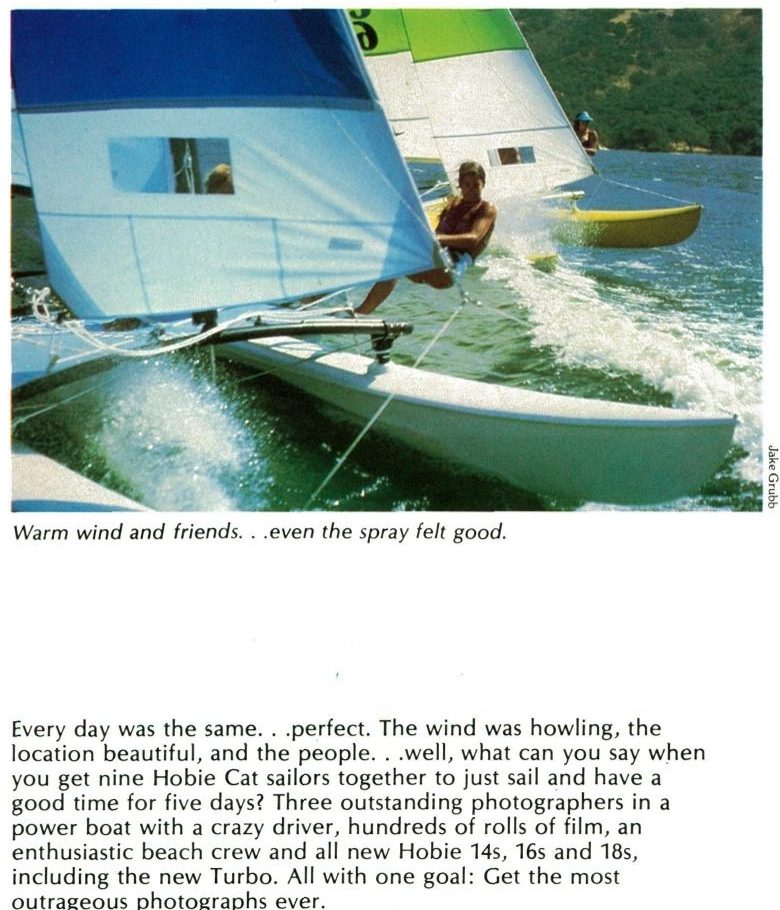
The 14 is the original, in production in the United States from 1968 to 2004 and later abroad. The Turbo is a 14 with a jib, and the jib brings a different forward rig: shorter bridles forked to a roller furler, a wire-luff jib that replaces the forestay, a pigtail above it, usually heavier eighth-inch shrouds, longer chainplates on the side rails, and a trampoline with two large grommets for the wire that carries the jib blocks under it.14 Aftermarket jib kits came first; Murrays was advertising a $175 roller-furling kit in the Hotline in March 1982, the same issue in which Hobie's photographers shot "all new Hobie 14s, 16s and 18s, including the new Turbo," and by July 1982 regattas had a Turbo 14 class.15 Miller dates the factory Turbo to 1982, and adds the detail that sorts an early 14 from a later one: dolphin strikers under the front crossbar have been standard on "all the 14s... since 1982."13 Trapezing is class legal on either version, but only with a striker. Adjustable rudder castings, as on the 16, put a 14 at about 1983 or later.
Hobie 16 by year
Miller's summary stands: "The basic structure of a Hobie 16 has never changed. Most changes over the years have been related to hardware... blocks, fasteners etc."17 The hardware is what dates a boat. The list below merges the factory's own list of significant changes with Anton Largiader's long-running forum compilation and the corrections it drew.1716 Bounds' warning applies to every line: Hobie 16s are hand-built in small numbers, "changes made their way into the boats after the inventory of old parts was used up," and 1995 in particular, when the company had just been sold for the third time in seven years and was importing crossbars and castings from France, "there was a lot of variation in the details."16
| Year | Change |
|---|---|
| 1970-72 | First boats. Sliding metal plate main traveler; mast base with a hook; four-digit pylon serial, no transom number. |
| early 1970s | Mast base changed to remove the hook; roller main traveler by 1972-74. |
| about 1977 | Three-hole mast tang. |
| late 1981 | Seaway jib cars standard (per a 1982 Murrays ad). |
| 1982 | Shorter shrouds, longer forestay, new mast step casting for more aft rake (factory list). The casting is Miller's quickest tell for pre- or post-1982. |
| 1983 | Double-grommeted rear trampoline lacing; red glue seam appears on some boats. |
| 1983-84 | Adjustable-rake rudder castings and straight tiller arms (arms first, castings second; owners report 1982 boats without, 1983 boats with and without). |
| 1984 | Construction change; class weight 340 to 320 lb. "A 1983 would likely be 340." |
| 1985 | Comptip mast and new main halyard; reef points dropped from the main (some lingered). See The Comptip. |
| mid 1980s | Flush boom vang fitting added, then removed; clear anodizing ends, black anodizing standard. |
| 1994-95 | Jib and main traveler tracks molded into the crossbar extrusions (shallow track for part of 1995, then deep); French injection-molded corner castings with integrated jib turning blocks; trackless pylon extrusion (early pylons were 14 mast sections); Miracle 20 style tiller connectors; shrouds shortened. |
| late 1990s | One-piece cast rudder gudgeons; updated bolt rope; Aussie jib halyard. |
| 2000-02 | Recut jib with a longer luff. |
| 2004 | Mast step and base revised again for rotation; 40 mm triple upper mainsheet block; roller-bearing jib cars; EPO2 rudders standard about 2004-05. |
| 2008-09 | Longer forestay, shorter shrouds, longer bridles. |
| 2013 | EPO3 rudders standard. |
Bounds' own list of what a 2004 boat has that a 1980 boat does not is the short version: rake-adjustable rudder castings and better rudders, revised tiller connectors, sails and traveler tracks, a low-profile mainsheet system, one-piece cast gudgeons, a hull about 20 pounds lighter, a Comptip mast with no reef points, a heat-welded trampoline, coated standing rigging, and no boom vang tang.19 Since the 1990s the changes that matter to a buyer are the integrated-track crossbars, the EPO rudders, and the 2004 mast step; a 1995 or newer boat gets everything else.18
Hobie 17 and 17 Sport
The 17 arrived in 1985 as the single-handed, high-tech successor to the 14's niche, with integral wings from the start and a boom so low forward that crews complained.21 The Sport is a 17 with a jib. Miller: "The boats are identical except for the jib on the sport," to which owners add that the Sport has a boomlet instead of a full boom, so a crew can cross, and a bow spreader bar with a different forestay system to carry the jib.20 The racing 17 (the SE) has a mast rotation control, which the class rules require; the Sport does not. Centerboards have always been fiberglass, "plastic is too weak to use, especially at the forward pivot hook"; rudders went through the same materials as every other Hobie, below.20 The Sport's stock jib is about 32 square feet.
When the Sport appeared is murky. Wikipedia says 1990; forum regulars say the early to mid 1990s; the Hotline was scoring a Hobie 17 Sport class at regattas by the end of 1991, so 1990 or 1991 is right.35 Early 17s were built to a 315-pound target and the decks are thin; Tom Kirkman's warning about drilling one, "a couple or three millimeters deep," is in the soft decks guide. Production ended with the 18 in 2003.
Hobie 18, SE, Magnum, Formula, SX
No Hobie confuses buyers more, because the names describe trim packages and options that were freely mixed. Miller's "short history" from the forum FAQ is the reference:22
Hobie 18 Standard... clear anodized aluminum. Hobie 18 SE... Black anodized aluminum, color tramp and sails. Magnum Wings... welded frame, length of tramp area. Hobie 18 Magnum... add (welded frame) "Magnum" wings (1984-85 ish). Hobie 18 Formula... made in Europe. 1 1/2' taller mast, Mylar main and jib. Hobie 18 Formula... Made in the US. Standard Hobie 18 with white powder coated aluminum. SX Wings... Riveted wing assembly, long seat ring oval. Seat extends forward of the front x bar and aft of the rear, nearly to the transom. Hobie 18 SX... Euro Formula design rig with US made SX (long ring) wings.
Matt Miller, Hobie Forums FAQ, June 2009
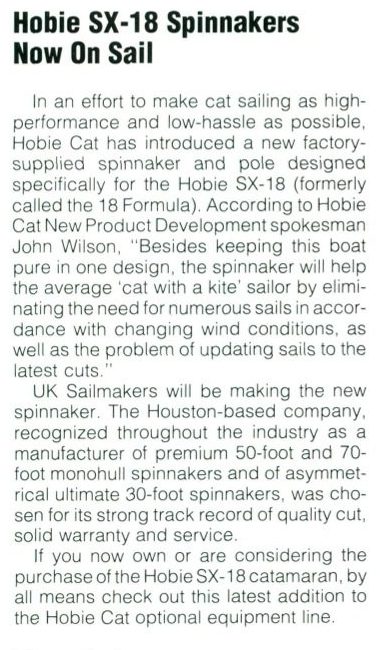
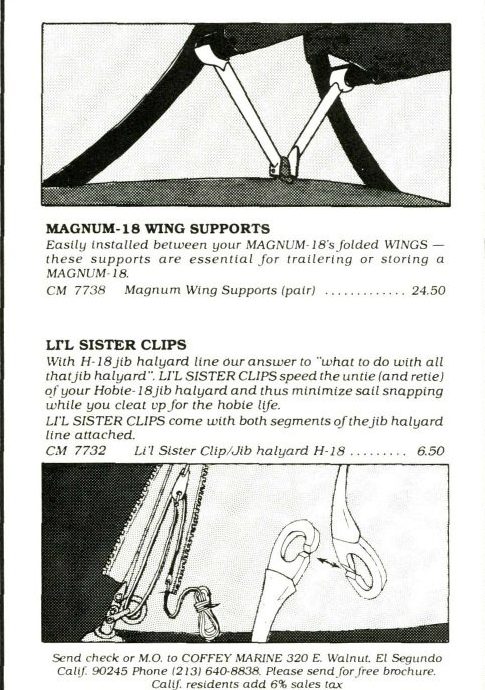
So in the United States there are really two boats, the standard 18 and the SX, and the difference is the rig, not the wings. "The magnum wings or SX wings can be installed on any 18, but that does not make it one boat or the other."23 A true SX has all three of a taller mast, vertically cut Mylar sails and the long riveted wings; "anything without those three is by definition NOT a SX," and a Magnum with a spinnaker is still a Magnum.23 Miller's FAQ gives the numbers: the SE's mast is 28 feet 1 inch with 240 square feet of sail at 420 pounds; the SX's is 29 feet 7 inches with 220 square feet (less area, much higher aspect) at 450 pounds. Beam is 8 feet on both.22 The SX dates from 1989: the Hotline announced a factory spinnaker that November "for the Hobie SX-18 (formerly called the 18 Formula)" and reported the first two SX-18s at a regatta that winter.26 Any 18 older than that was sold as something else. Magnum wings were on sale by early 1984, when the Hotline was already advertising supports for folded ones.27 Early Mylar SX sails were prone to delaminating, and few SXs were built, so a complete class-legal one is rare.23
The hulls matter more than the trim. The forum's consensus history, from Damon Linkous of TheBeachcats and confirmed in outline by Miller, runs in four eras.25241978 to 1983: the heavy original layup, "nearly indestructible," built in large numbers. 1984 to 1986: a lighter layup to compete with Prindle and Nacra, with a smaller glass patch at the crossbars inside the hull; these are the "red line" or "red glue" boats, named for the red adhesive visible at the deck-to-hull seam, and they are the ones that cracked at the front crossbar, especially with wings. Miller: "The addition of wings at the same time over stressed the crossbar connections... We added a set of stainless plates in about 85-86 and finally cured it with a big glass patch in 1988-89 construction."24 1987 to 1988: the same shape with extra glass at the beams, the D-shaped stainless rail reinforcement plates bolted through the hull at the front beam and shroud points, and the upgraded rudder system with plastic cams. 1989 on: the best layup, light and stiff with the reinforcement built in, and a redesigned daggerboard trunk; sales were low by then, so they are hard to find.25
Two more tells. The hull graphics changed in 1983 from a white-outlined "Hobie Cat" near the transom to a black one with "a Coleman Company" beneath it; there is no such thing as a "Coleman hull," but a Coleman-era boat is a 1983 to 1988 boat.24 And early daggerboard wells were three separate moldings bonded on flanges, which after twenty years leak at the flange and need re-gluing from inside rather than sealant on the outside.22 On any mid-1980s 18, look up under the deck lip at the four crossbar and shroud attachment points: hairline gelcoat crazing is normal, cracks through the glass are not, and the four-bolt stainless anchor brackets should be present on both the inboard and outboard front connections. The part is still listed as 64130001, Rail Reinforcement Kit, one kit per position.2425
Hobie 20
The 20, sold as the Miracle 20 and introduced in 1991, is a different animal: a pure racing boat, "very overpowered," described by one moderator as "angry."29 It is easy to identify and hard to confuse, with its flat decks, daggerboard trunks, the long Miracle rudder blades, and a foam core that runs further down the hull than on the 18, which is why it wants beach wheels. The flat deck is also why older 20s get soft alongside the trunks. There is one Hobie 20 sail pattern guide in the forum FAQ for dating sails.12
Hobie 21 SE and 21 Sport Cruiser
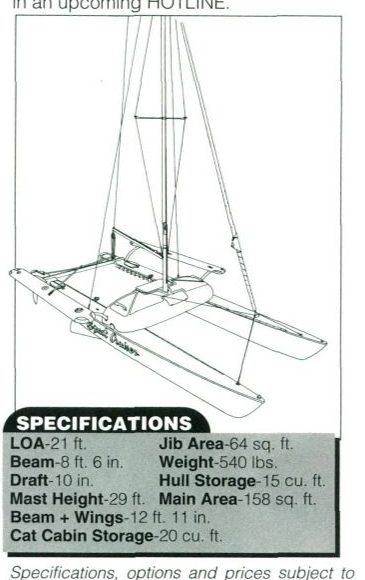
The two 21s share hulls and wings and nothing else that matters. The SE, built from about 1987 to 1990, is a big racing boat: around 565 pounds minimum by class rule and 600 rigged, a mast of about 33 feet that Bounds calls "a telephone pole - you need mechanical assistance to raise it," and crossbeams that extend the beam to about 10 feet for sailing and retract for the road.29 The Sport Cruiser, announced in the Hotline in November 1992, is "a toned-down version of the 21 with a smaller sailplan, road-legal width and a storage cuddy on the front of the trampoline."29 The launch specifications were a 21-foot hull, 8 foot 6 inch beam (12 foot 11 inches across the wings), 29-foot mast, 540 pounds, a 158 square foot reefable furling main and a 64 square foot furling jib, with cat cabin storage and a forward mesh trampoline.28 Even the masthead fittings carry different part numbers, and the Comptips are different lengths; this site's Hobie 21 section has the specification table and the mast drawings.
Telling them apart on a trailer takes one look: the SC has the forward trampoline and the molded storage cabin ahead of the mast, a roller-furling main on a shorter mast, and fixed 8-foot-6 beams. The SE has the taller mast, full-batten racing main, extendable beams and, usually, a spinnaker snuffer.
Rudders as a clock
Rudders get replaced, so they only date the rudders, but Bounds' rudder history is a useful second opinion on any boat and settles what you are being sold.30 The first 14s and 16s had ABS plastic blades, yellowish white, that yellowed further in the sun and broke off below the casting. By the mid to late 1970s the factory switched to injection-molded Lexan: whiter, waxy-looking, flexible and heavy. In 1983 came the EPO, a black epoxy-foam-core fiberglass blade, light and thick and prone to humming until the trailing edge is dressed; left in the sun the coating wears off and the glass shows. When Coleman sold Hobie in late 1988 the EPO tooling went too, replaced by black PCG plastic blades and black or white fiberglass "Racing Rudders." White nylon blades followed in the mid 1990s, European carbon blades with a gray Hobie logo about 2003, the EPO2 (white, carbon or carbon-Kevlar, with the EPO2 logo) about 2004, and the EPO3 with a carbon trailing edge in 2013. A boat with white plastic rudders is either a 1990s boat or an older one with replacement blades; a boat with black EPOs is probably a 1983 to 1988 boat that was raced.
Inspection checklist
Compiled from the forum's buying threads, which agree on almost everything.31323334 Take a friend who owns the model, go in daylight, and ask the seller to rig it.
- Hull number. Find it on both transoms, decode it, and check it against the hardware above. Mismatched hulls mean a replacement; a missing number means paint.
- Hulls. Palm and thumb every inch of deck and side, hardest in front of the front pylons and in front of the rear crossbar. Knock for dead thuds. Look for waviness along the sides. Any soft spot is a price negotiation at best; see the soft decks guide. Check the keels and bottoms for dragging wear, dents and deep scratches. On a 14 or 16, check the pylons are tight in the hulls with no cracks around them. On an 18, look up under the deck lip at the crossbar and shroud anchors for cracks through the glass, and confirm the stainless reinforcement brackets.
- Water. Pull the drain plugs. After a test sail, see how much came in. On a daggerboard boat the trunk seal, especially at the top, is the usual leak.
- Frame. Corrosion and pitting on crossbars, especially where stainless meets aluminum, at the dolphin striker, and where the rear crossbar bolts pass through. Check the mast step casting inside and on top for corrosion and wear. Rivets tight. Castings not cracked.
- Mast. Sighted straight. Comptip present and sound on anything 1985 or later; see The Comptip. Halyard and cleats present; riveted blocks are a job to replace.
- Standing rigging. Kinks, broken strands, rust at swages, corroded chainplates. If the seller cannot say when it was replaced, budget to replace it; a visual inspection does not guarantee a shroud, and old boats were rigged with less rake than today's standard lengths give.
- Sails. Unroll them. Crisp, not soft; no bleached band along the foot from being left wrapped on the boom; no mildew; stitching, luff rope, batten pockets, battens and caps all there. Blown-out sails are the most expensive thing on the boat.
- Rudders. Blades not chipped or delaminated; cams and rudder locks working, not beaten; tiller arm connections tight; which material they are.
- Trampoline and lines. Tears, worn lacing, grommets; replace a trampoline older than about ten years. Stiff or stained running rigging is done.
- Completeness. Go through the parts list for the model (this site has the manuals and parts guides for each) and inventory what is missing. Goosenecks, cleats, jib cars, tiller extensions, trapeze gear and righting lines add up fast; one "free" 16 cost its owner $700 to sail.
- Trailer. Bearings, tires, lights, rollers and the mast support. A bad trailer can cost more than the boat.
- Provenance. How was it stored, was it rinsed after salt water, was it raced (racers maintain boats). Why is it for sale. "Don't be desperate and don't be afraid to walk away from a bad deal."33
On price, the forum's benchmarks have barely moved in fifteen years: a sound but older 16 with decent sails in the low thousands, a restored one with upgrades somewhat more, and anything asking the top of the range should have the upgraded mainsheet, low-profile jib cars, EPO rudders and fresh wires to show for it.32 Cheap boats are not ready to sail: "They'll swallow a few hundred bucks in parts and lines before you blink."29