This is the third of three articles. Rig Tuning covered what is set on the beach and Sail Controls and Power the strings pulled afloat. This one is about the boat-driving that both of those exist to serve, and it calls back to them where a tuning or trim choice decides how a maneuver goes. A catamaran is not a dinghy: it is wide, it carries its weight in two hulls that would rather go straight, it has no keel to pivot on, and it accelerates and stops faster than anything with one hull. Most of what follows is about using those facts instead of fighting them.
Weight, helm and balance
Half the weight of a loaded Hobie 16 is the people on it, so where they sit is the first control. Hobie's own guide starts there: sit on the upwind side just in front of the tiller, facing the sail, forward hand on the sheet, aft hand on the tiller, one foot under the hiking strap, and move outboard as the boat heels. Steer with small movements: "Keep the movement of the tiller to a minimum to prevent over-steering."1 Upwind, Matt Bounds wants the 16 "sailed 'on its nose' - leeward hull depressed, windward hull just kissing the surface, sterns out of the water"; off the wind, level but still with the sterns out, "being careful not to get launched." In light air the skipper sits on the weather corner casting leaning out over the hull and the crew mirrors on the leeward side; as the wind builds the crew comes to windward along the front beam, then onto the side rail, then hooks up, and the skipper goes out last because "going in or out on the trapeze distracts the skipper." Keep the two bodies together: concentrated weight stops the boat hobby-horsing in chop, and in light air "imagine you're sailing on a sea of eggshells."16 Wick Smith's 17 rule is the same: as far forward as wind and waves allow, even on the wire, then back and out until "in really big air, you are trapping at the back of the wing."15
The sails steer as much as the rudders do. Rick White's demonstration is to sail with the rudders up: sheet the main and the boat heads up, sheet the jib and it bears away. "To bear off, ease the main and sheet in the jib. To head up, ease the jib and sheet in the main."1716 Weight steers too. A boat that heels wants to head up, so you must have it flat before you try to bear away, and a crew on the aft corner swings the bows the other way. White's four rules of weight are worth memorizing: a heeling boat heads up; a boat must be flat to bear off; going forward on the new windward hull after a tack flattens the boat so it can bear off and accelerate; and the lighter the wind and the slower the boat, the more weight movement matters.17
The feel in the tiller is set partly ashore and partly by trim. A little weather helm is right; a boat that fights you upwind has too much rake or too little rudder rake, and one that is dead in the hand will not feather in a puff. In flat water and a breeze, feathering is the technique: "When a gust hits, allow the boat to heel a little and round up on its own... Just when you think the whole boat is going to stall, bear off again to pick up speed." In waves the opposite, "you'll get killed trying to feather. Power is the name of the game here. Foot off to avoid getting stopped by the waves."16 Schafer's 1977 version: when chop kills your speed, crack off for a better angle through the waves, "and 90 percent of the time it will pay off, even though you sail a longer course."5
Set ashore. Helm feel is a beach setting first: rudder rake and toe-in decide whether the tiller is neutral, light or heavy, and mast rake decides how much weather helm the sail plan carries. See rudders and measuring rake in Rig Tuning. On the water, the traveler and jib trim move the helm too: see mainsheet and traveler.
Tacking
Every Hobie tacking article begins with the same sentence, and it is the one that matters: have speed before you turn. "If you 'feather' up into the wind prior to tacking, you will risk not making it."15 The second rule is to turn with the rudders at a moderate angle, not jammed over: Schafer said about 20 degrees on a 14, Smith no more than 45 on a 17, Matt Miller three-quarters of full, because past that "the rudders act as brakes."51519 The third is the one newcomers miss: ease the mainsheet as the bows pass through the wind, a foot on a 17, two feet on an 18, "several feet" in a fresh breeze, otherwise the sheeted main weathervanes the boat head to wind and holds it there. And do not sheet in again until the bows are well onto the new tack and the boat is moving, because sheeting early heads it straight back up.111719
Hobie's guide gives the basic sequence for a two-person boat: close-hauled and moving, push the tiller away slowly; as the boat comes head to wind ease the main a little, move across, swap hands, and start straightening the rudders; the crew eases the jib just after the main is released and sheets it on the new side before the main is trimmed, which "will prevent the boat stalling head to wind."1 Miller's fresh-breeze FAQ adds the detail: keep the jib sheeted until it backwinds, then force the mainsheet out several feet; keep your weight well aft and hiking "right through the tack until the main sail nearly backwinds before trying to cross over"; keep the helm over even while switching sides; look for a swell to bank off as the boat passes head to wind. "If you stall, reverse the rudders as the boat begins to back up and be sure the sheets are well out."19 The weight-aft part has a limit in a blow: Bob Johnson warns that too far back on a 14 lets the wind under the trampoline and "you will do a 'back flip'," and Crary says the same for crews on a 16, so in heavy air cross in the front.107
Timing with waves matters more than most of the rest. Tony Laurent: look for a smooth patch between waves and drive the boat around them, and "if the waves are large, it usually helps to begin your tack as you go up the face of a wave. Hopefully, the extra wind that is at the top of the wave will help minimize your trip through the stall zone."9 Tucker: "Take a look at waves approaching the bow, time your move and once you make the decision, commit. Don't hesitate."11 And a tack is always a loss: a 14 making ten knots gains a dozen boat lengths on one that takes ten seconds to tack, which is why Schafer told racers to practice "tack after tack and jibe after jibe."5
The roll tack
Rick White called the catamaran roll tack "the most important refinement in catamaran handling over the past decade," cutting tacking times "from 25-35 seconds to 4-7 seconds."17 The idea is to use weight to lift the bows and pivot the boat on one stern. Bounds's picture: "It's almost like doing a 'wheelie' on a bike. Done right, you can shave a few seconds off your tacking time. Done wrong, you end up going over backward."16
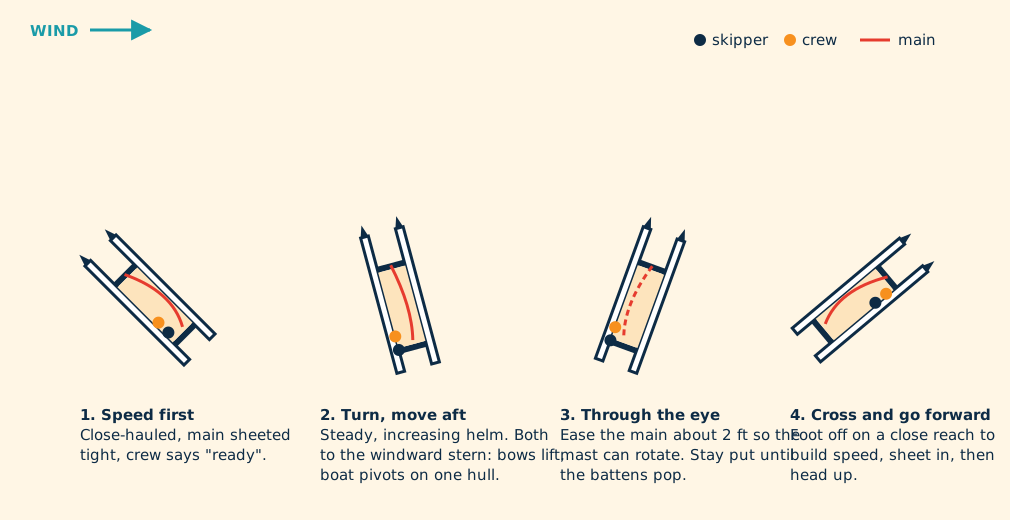
White's step by step. "Ready about," then "helm's alee." Push the helm with steadily increasing pressure and at the same time move, with the crew, to the aft windward corner, and stay there until the boat is through the eye and on a close reach of the new tack. "By moving to the aft windward corner as the boat is turning, you are lifting both bows clear of the water, thereby reducing drag and making it easier for the boat to turn... the waterline of the old windward hull will be reduced to nearly half. So, you are reducing your wetted surface to about the size of a Laser." Never start a tack with the main loose, because the sheeted main helps the turn; ease about two feet as the bows pass through, more in chop or wind. Once on a close reach, cross and go forward to the main beam, foot for a moment to get flow over the boards and rudders, then sheet in and head up. Two cautions: do not move aft until the turn has actually begun, because sitting on the stern while going straight only slows the boat; and "never let go of the tiller... or allow the rudders to straighten out even for a flicker at any point during the tack."17
On a single-hander the roll tack is the only tack that works, and Carlton Tucker's 1986 article is the one everyone learned from. In light air (under six mph) sit near the front crossbar, push the helm away slowly, "and I emphasize slowly because, in my opinion, it's easy to stall unirigged cats," slide aft a little, ease the sheet about a foot as the boat comes head to wind, and stay on the old windward side, which becomes the leeward side, until the battens pop and the mast rotates. A trick: before crossing, pull the boom toward you from the leeward side to loosen the sail, "having the hulls move around the sail, so to speak." Sail further through the wind than you think you need to; irons costs more than an over-rotated tack. In moderate air (8 to 15 knots) "the trick, as they say, is in the timing": come in off the wire and sit on the wing first, turn a little faster, crack the main no more than a foot, and when you are sure the boat will make it "and you just can't wait any longer to go over, blast to the other side of the boat while tossing the tiller across behind your body." In heavy air everything is faster, the main is eased more because "you're not so concerned about stalling as you are about capsizing," and you get to the new wing while the boat is still turning. "Chances are good that you'll capsize your first few tries."11
Tacking from the wire is the refinement on top. Smith's drill: in moderate trapezing wind, tack ten or fifteen times coming in just as you push the tiller over, then ten or fifteen more waiting half a second, and keep pushing until you find your limit; "you can wait up to a full second without blowing the tack." The old adage about staying out until your back hits the water "doesn't apply to the vast majority of non-gymnasts in the crowd... The next sound is usually the mast hitting the water." The three-hands problem, tiller, trapeze handle and sheet, is solved by Tucker's grip: uncleat the main before the tack and hold sheet and tiller together in the back fist with the ratchet on, so the main eases as the tiller goes over and the front hand is free for the handle. Leaving the main cleated is easier coming in, "however, if you don't get to the cleat in time to release it, at best the boat goes into 'irons,' and at worst you blow over backwards!"15 Smyth adds that on the 17 the mainsheet stays tight "up to the moment the battens pop over," then "let the mainsheet out a lot to allow the boat to continue turning," and that weight at the back third of the wing helps the pivot.12
The crew's tack
On a 16 or 18 "the crew is totally in control of making this a great tack."17 Terri Crary's 1983 guide is still the best description of the job. It starts with communication: a skipper who calls "Ready about?" fifteen seconds ahead, a crew who answers "Ready!", and "Hard-a-lee!" as the rudders go over, the same words every time. Before the turn, pull the slack out of the lazy sheet so there is less to haul after. If you are on the wire, come in before the turn, because once the boat heads up "the change in the wind force on the sail will cause you to hang lower, making it harder to get back on the boat. If you stay out on the wire too long, you'll get dunked and might even pull the boat over." Cross in the back of the boat except in heavy air, taking the windward sheet with you.7
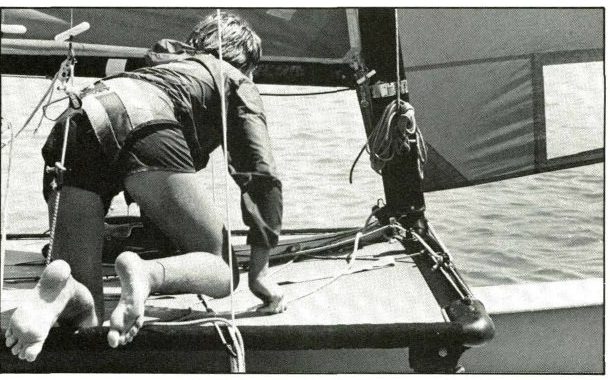
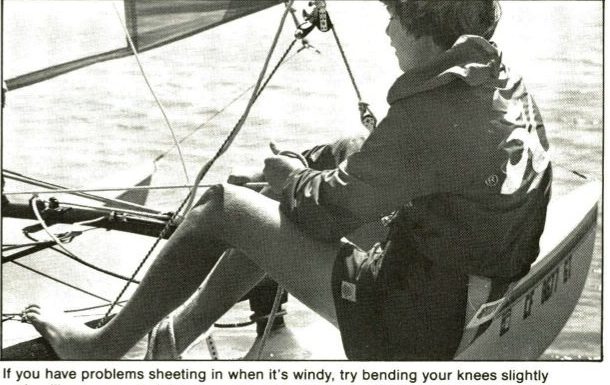
Then the backwind. Uncleat the jib with conviction (pull back with one hand and push down behind the cleat with the other, not "thump, thump, thump on the tramp"), and let it out until the leech is about an inch and a half from the mast. Hold it there until the boat is about 20 degrees past head to wind, longer in chop, less in smooth water, "a fairly sure-fire method of judgement is to let the jib go over the split second the mast rotates." Bounds's rule is the same in different words: hold the backwind "until the wind indicator reaches the tacking arm, or until the mast rotates, whichever happens last," then let the sail blow across rather than pulling it with the sheet, sock it in hard for a second or two to get the boat going, ease a couple of inches, get out on the wire, check that no batten is caught, and trim.716 Rick White disagrees about the backwind: in his roll tack "the jib is never back-winded through the turn," the crew eases the old sheet and pulls the new one from right at the block so the jib keeps drawing the whole way round, and comes out of the tack sheeted harder than the main so the boat wants to bear away. Both camps agree on the end: do not strap the jib in block-to-block while the boat is still slow, because that chokes the slot and stalls the main; "delay your superhuman efforts a slight moment until the boat gathers up more speed."177
The hang-ups are predictable. On a 16 the jib sheet catches in the halyard cleats on the mast (bundle the halyard tails into the cleats) and the jib battens catch on the halyard in light air (pass the halyard behind the shrouds before cleating it). On an 18 the sheet catches on the mast rotator, so lift it clear as you cross. When the jib itself catches on the mast, stand up, grab the leech high, push forward so the battens bow toward you and pull it across in one shove: "One good shove works better than several half-hearted attempts."7 In heavy air the one thing to fear is a jib sheet stuck in the cleat, which is how a boat capsizes "in a very undignified manner."16
Irons
Irons is the boat stopped head to wind, sails flapping, no steerage, and it is the normal failed tack on a catamaran. With a jib the fix is in every manual: back the jib, reverse the rudders, let the main out, and when the bows are across sheet the jib on the new side and the main slowly. Hobie's guide adds "push the sail forward to back-wind it" and that sculling the rudders violently is legal.116
Without a jib it takes a method, and the one taught to every Maui rental customer is Gale Notestone's. Hobies there are sailed main-only in the trades, tacked never jibed, and "even a couple of instructors have put themselves in irons while sailing without a jib." The procedure: decide which tack you want, say starboard. Point the leading edge of the rudders (the corner where the crossbar meets the rudder arm is the easier thing to look at) to starboard. The wind is now pushing the boat backward. Let the sail go completely free, "sheets must not be cleated, tangled or sat on," and it will blow out to the side. Keep the rudders over. If you want it faster, push the boom out to the same side as the rudders to backwind it. The boat backs around; once it is across the wind, straighten the rudders and it starts forward on its own, then trim the sail and move the crew to their places. Change sides if you must, but "he must keep the rudders steady." Crew forward keeps the bows down while all this happens, and with the main sheeted hard and centered the boat will sit in irons as long as you like, "the best way to watch whales with the least amount of movement."13
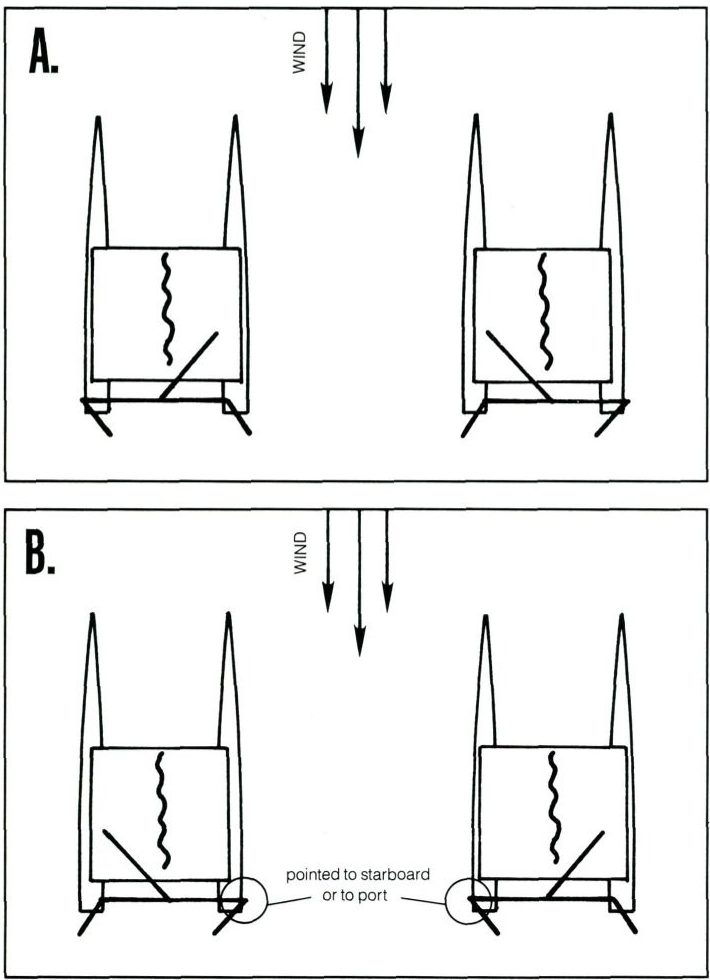
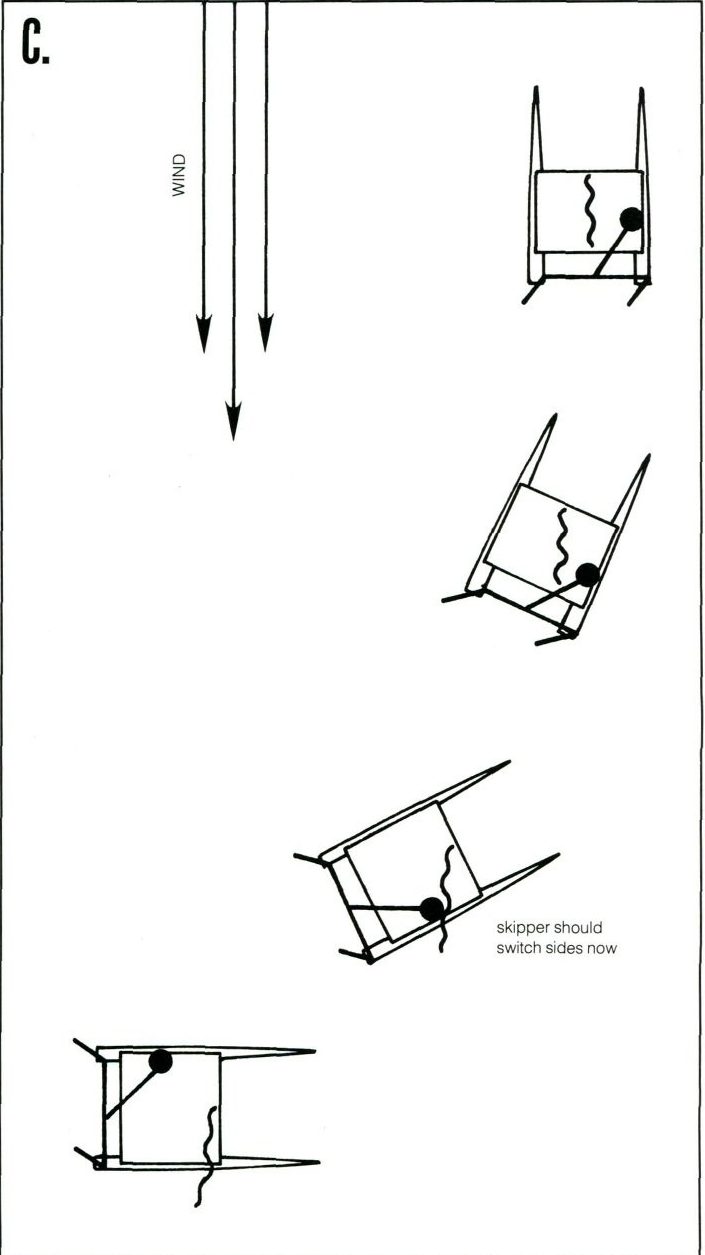
The single-hander's version is Tucker's three-point turn and Smith's rule six: if you are through the wind but not far enough off it to go, push the tiller toward the new leeward side and push the boom all the way out on that side; the boat backs onto the proper course, then sheet in and go.1115 Laurent's heavy-air "reverse tack" on the 14 makes the stall deliberate: drive hard into the wind, cross straight away staying forward, push the boom hard away, wait a few seconds while the boat reverses, then straighten the rudders and sheet together. "It sounds complicated and it is."9
Jibing
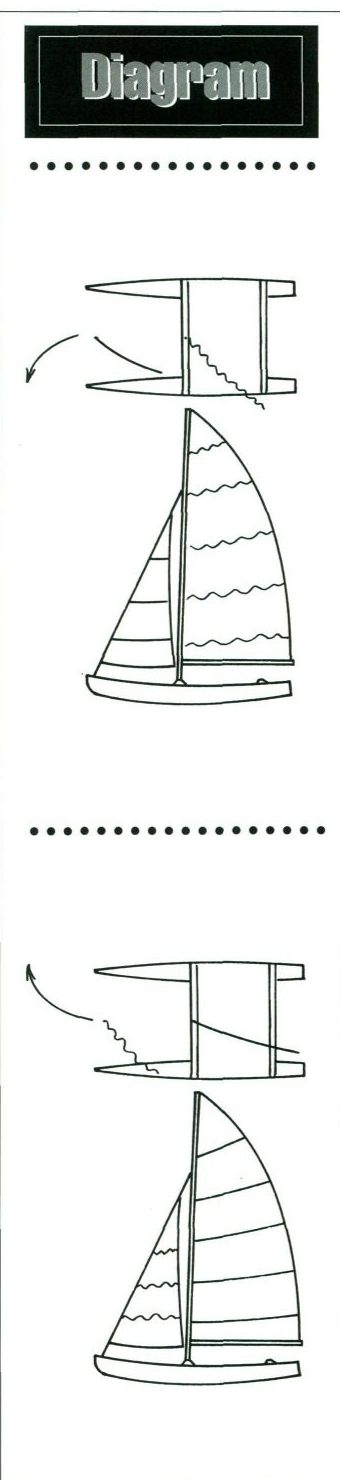
"Jibing is not nearly as complicated as tacking. Your main concerns are to avoid pitchpoling and to keep the jib from wrapping around the forestay."16 Hobie's guide: turn away from the wind letting the sail out, keep the turn steady, start pulling the sheet back in as the boat nears dead downwind so the sail does not slam across, duck, keep some tension on the sheet as it crosses, then ease quickly on the new side.1 Bounds's racing version for the 16: tell the crew, slide to the back of the boat, put the weather rudder down, carve into the turn, flip the tiller to the new side and rest it on the corner casting, grab all the parts of the mainsheet and "just before the sail blows over on its own, throw it over," pull up the new weather rudder, then slide forward and build speed. The crew kneels in the center facing forward, takes up the slack in the weather sheet, sheets in as the boat turns down so the jib cannot wrap, lets it blow across when it backwinds, and goes forward. In light air do not bother switching rudders, pull the jib across by hand, and hold the sheet parts a moment longer to snap the battens over. In heavy air "you might need both rudders down just to maintain control. Keep your weight well aft and watch your speed going into the maneuver. If you try to turn too fast, you'll get launched."16
The 1973 Hotline drew the line between two heavy-air jibes. The racing jibe: sheet in as far as you can while keeping steering, bear away until the boom can be swung, have someone grab the boom or the sheet parts to start it, and "as the boom crosses the centerline, the helmsman must stop turning the boat and head it straight downwind," because continuing the turn as the sail slams across is what capsizes the boat. The survival jibe: leave the sail out, keep turning by the lee until the wind throws the boom over, and keep turning fast so the sail is luffing when it fetches up, then gather your wits. Jibe when the boat is going fast, because speed lowers the apparent wind; never while accelerating in a puff or slowing on the back of a wave, but gladly while surging down the face of one. Or sail past the mark and tack, "be prepared to be called 'chicken' at the bar, but perhaps it is better to be a wise chicken than a wet rooster."3 Schafer's 14 method is simpler: swing the tiller extension to leeward parallel to the tiller bar, steer through, and grasp the sheet "both to start the main across and to cushion the shock."5
Trapeze
Hobie's FAQ on getting out is the clearest. Hook up first ("that will always get you if you forget that step"). Turn a little forward, forward foot on the rail, aft hand braced on the rail behind you, forward hand on the handle; ease out over the rail until the wire takes your weight, push out with the aft hand until the aft foot reaches the rail, then extend the aft leg. Forward leg rigid, aft leg slightly bent so you do not fall forward; feet at least one and a half shoulder widths apart, wider in rough water and on fast reaches. Coming in, bend the knees, slide the aft leg onto the boat with the forward hand on the handle and the aft hand on the rail, then lift with the handle. Single-handed with main and tiller: sheet in and settle the boat on a safe course, check for gusts, lay the tiller on the rail behind you with your palm over it, uncleat the main and hold it in the aft hand on top of the tiller, then go out as above and take the sheet back in the forward hand once you are over the side. "Best to learn how to do it with the cleat un-done. I have been hit by puffs when in mid transition."21
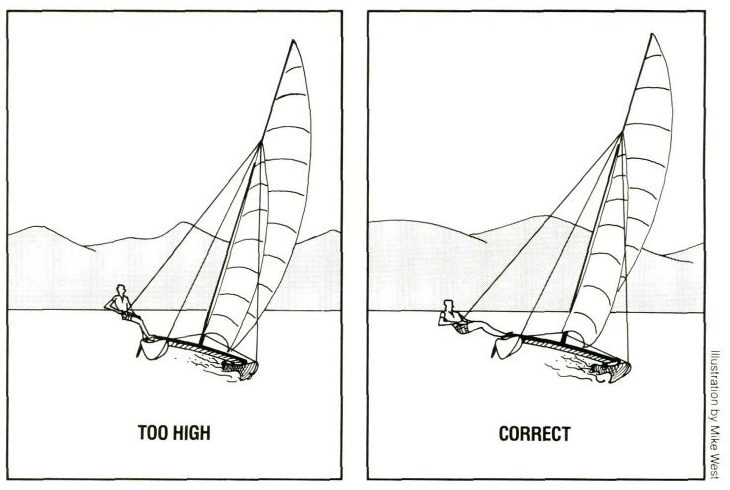
Height. "You're trapezing too high!" was John Hackney's answer to the most common question. The body should be parallel to the water with the windward hull just touching; higher or lower reduces leverage. Marginal wind with big waves pounding the crew is a reason to come up a little, "but the occasional butt buster (waves hitting you) is not an excuse to raise the trapeze height... Lower those trapeze wires, take a wave on the rear now and again; it builds character!"8 Bounds's way to set it on the beach: pull the handle down to the side rail, and the height is right when the bottom of the handle is level with the bottom of the rail. Then "let the wire carry your weight; don't hang onto the handle with a death grip; keep your feet apart for stability; and lean back."16
Heavy air and downwind
Hobie's first heavy-weather tip sheet, in 1971, holds up. Rake the mast back to keep the bows up off the wind. Watch weight trim: too far aft too fast in a tack and the wind gets under the trampoline and flips the boat backward; too far forward on a run and it pitchpoles. "Don't let go of the mainsheet! If you do cleat it keep it in your hand." Avoid running dead downwind in a big breeze, broad reach and head up a little to take pressure off the sail and lift the bows; do not run straight down the face of a swell, angle off near the bottom; tack rather than jibe unless you are expert; upwind, travel out ten to twelve inches. In a squall a 16 can sail under main alone or jib alone; a 14 can run for a lee shore under bare poles. If you capsize and the boat blows over again when you right it, take the sail off. "STAY WITH THE BOAT."2
Upwind in a blow the order is traveler out, main sheeted hard, and only then the sheet in the worst gusts; Hackney explains why in the sail-controls article and it is the same on every model.8 Smith's rule for driving a 17 at the Gorge in 40-knot gusts: find the point where the boat is overpowered and sail a fraction above it, head up in the puffs, and come back down "AS SOON AS the puff has passed... If you are comfortable with your line and the boat is in control, you aren't sailing low enough or hard enough."15 Off the wind the danger moves to the bows. The 1973 article on reaching in heavy air: all the weight aft over the corner casting, crew on the wire straddling the skipper, the skipper's job to keep the lee hull from pearling, the sheet eased in the puffs so the head of the sail twists off and sheeted again when they pass, and if the boat rounds up against the rudder, ease the main and hike back, but gently, because doing it violently starts "the boat veering off to leeward, with the mast coming over to windward in a typical death roll."3 On a run in 25 knots Smith keeps the blocks within two feet, travels in six inches, and sails nearly dead downwind so the wind strikes the sail a glancing blow rather than at 90 degrees, "dramatically increasing the chance of pitchpoling. Yes, a 17 can be pitchpoled in these conditions." On a hairy reach, "discretion is the better part of valor. Use a lot of twist, pump the sheet, and if the conditions are too hairy, sit on the wing rather than getting out on the wire."15
In ordinary wind the fast way down is the opposite: tack downwind with the wind indicator at 90 degrees to the boat, "bear off on the gusts and headers, head up in the lulls, and jibe on the lifts," and use the waves. Broad reach to catch one, bear away with it, and the apparent wind comes forward and speeds you up. In light air, weight well forward and near the centerline, and keep the main from slatting by standing in it or holding it out with a foot.165
On the water and ashore. The gust tools are in Sail Controls: traveler first, sheet tight, and on the 20 the downhaul from the wire. The beach setting that keeps the bows up is rake; see why rake matters in Rig Tuning.
Capsize and righting
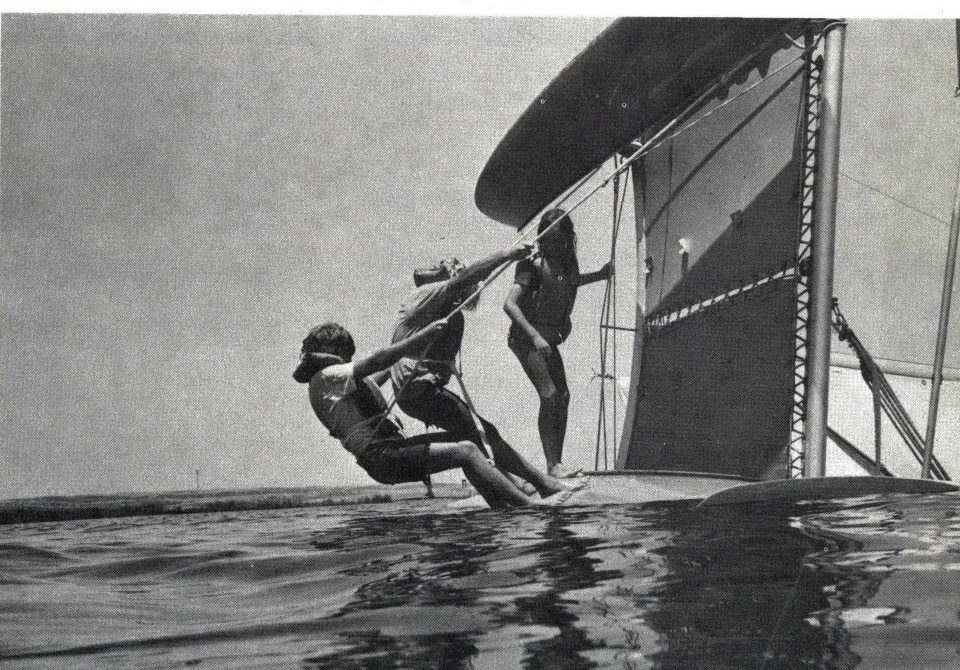
Hobie's instructions have not changed since the 18 manual: stay with the boat, it will not sink. Uncleat the mainsheet. Turn the hulls and mast into the wind if you can, by swimming the bows or the mast around, because there is less wind resistance and better control that way. Climb onto the lower hull, throw the righting line over the upper hull, stand up, and lean back on the line at about 45 degrees, "get as close to the water as you can. Try to stay out of the water." As the mast lifts and the upper hull starts down, drop to your knees and into the water, holding the righting line near the crossbar or the dolphin striker so the hull does not fly over and capsize again on top of you, and so the boat cannot sail off without you. "Be well aware of the hull and crossbar coming down over your head." Then climb aboard, sheet in and go.18201
The problem is weight. Dave Yost's 1975 system did not change the physics, "you still need roughly 250 pounds crew weight (for the Hobie 16) to make it work," but it made the line instant: a retracting righting line stored under the trampoline on shock cord and blocks, pulled out into a loop to lean back in, used from either side, and retracted before the crew was back aboard. The photographs of children under eleven righting a 16 with it were the point.4 For a crew that is simply too light, Hobie's answer is the righting bucket, hooked to the boat, thrown over the upper hull and filled with water, strap over the shoulder; the forum's is the righting bag and the various pole systems.20 And there is the wind. With the bows pointed into it and the jib sheeted on the low side, pulled in through the trampoline lacing at the lower traveler car while you lean on the righting line, the jib fills from underneath and helps sail the boat up. A 140-pound sailor righted a 16 alone this way in an estimated 10 to 15 knots. Never cleat the jib doing this, and grab the dolphin striker as the boat comes up or it will leave without you.14
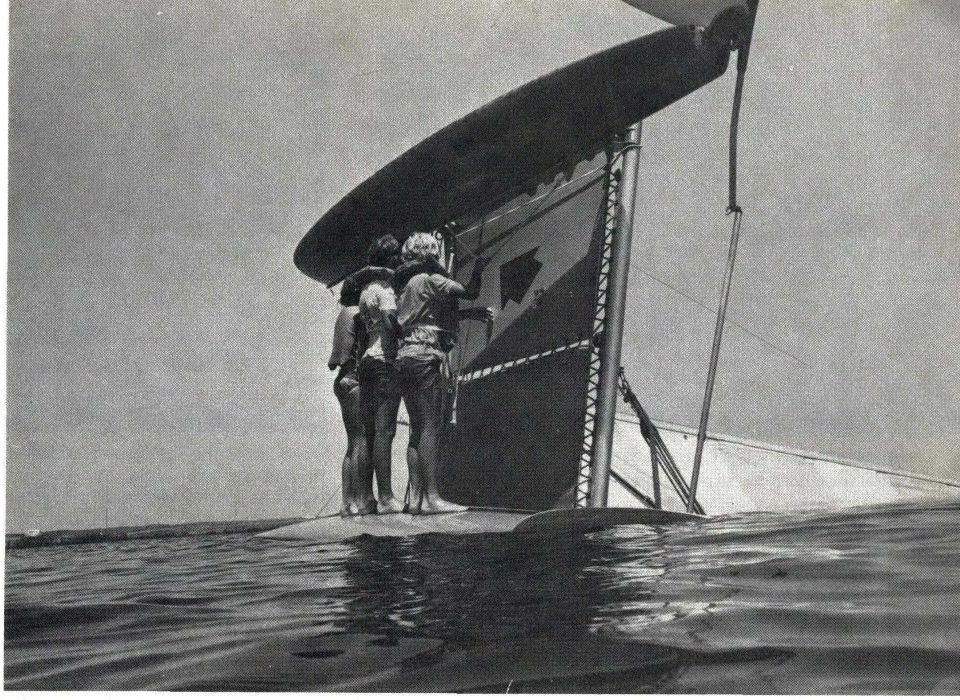
Turtling is the capsize to avoid. A sealed Comptip mast floats for a while, an older aluminum mast that has taken water does not, and in waves either can go over; Hobie's FAQ puts preventing it first and recommends a mast float, and the Hobie Bob or an equivalent is standard equipment for anyone sailing alone or with a light crew.20 A turtled boat is righted in two stages, first to the side, then up, and a line from the upper bow to a helper or the shore does what body weight cannot. The 1971 advice still applies after any capsize that will not come up: take the sail off, stay with the boat.2
Launching and landing
Launching is easiest pointed into the wind, sails loose and uncleated, floated out until the rudders can go down; steer gently until they are locked. Landing on a beach is the same in reverse: arrive on the point of sail nearest head to wind so the sails can be let go. With an offshore wind, plan the last tack so it approaches nearly head to wind and give yourself extra room on the previous one. With an onshore wind, come in from the side, turn sharply into the wind just short of the bottom, raise the rudders and drift back onto the sand. Keep the boat head to wind on the beach with the sail out and uncleated.1 Dock on the leeward side of a dock, slowly, and practice first with a friend standing on it.1
Surf is a different sport, and the Hotline's 1983 guide is honest about it: "The very best way to learn to sail out through the surf is to do it with someone who already knows how." The preparation: nylon rudder pins that break before a gudgeon tears off, a cord from each rudder casting to the hull so a lost rudder stays with the boat, spare pins and plugs, the mainsheet laid out on the tramp, the tiller on the right side, and a talk with the locals about rocks and kelp. Crew as far forward as possible on the way out, watching for swimmers, and if a wave breaks over the boat, down low, eyes and mouth closed, holding the dolphin striker. Wait for the lull between sets, then "once you decide to go, don't hesitate. Go." Run the boat out knee-deep, shove it off the wind so there is time to sheet in before it heads up, jump on, sheet in and get the rudders half down, "if they're down enough to steer, they're fine," and do not lock them until you are clear. You need at least eight knots of wind; high surf and weak wind means stay ashore. Whitewater has little force; the dangerous waves are green and vertical: weight forward, steer five degrees off the wave so it lifts both hulls without turning the boat head to wind, ease the main a little as it hits the sail, then sheet in and drive for the next one. If you give up, get off at the bows and walk the boat in from the sea side, never between boat and beach.6
"More people get hurt on the way in than on the way out." Pick the landing from the wind signs on the beach before you commit, sail a course that keeps you between waves, and keep the boat flat, because a hull picked up on one side turns the boat and that turn is a capsize. Release the main if a wave is going to hit it. Crew just behind the shroud, ready to move aft and hang on when a big one comes. At the beach the crew releases the jib, hops off and holds the bow while the skipper raises and locks the rudders. If you pitchpole in the surf the mast will probably break; get clear of the jagged ends and loose wire, find your crew, and walk the boat in from the sea side. If the mast survives, uncleat everything and turn it out to sea so the next wave rights the boat instead of rolling it onto the mast.6 Hobie's own safety page puts it more bluntly: "Do not take the boat out in the surf and do not head out for the ocean unless you are a real professional."1