A Hobie has no backstay, no vang worth the name and no adjustable spreaders you can reach from the trampoline. What it has is a handful of lines, and the whole art of making it go, or making it stay upright, is knowing which line changes what. This article is the second of three. Rig Tuning covered the settings made ashore; this one covers the controls used afloat, with a box marked Set ashore wherever a beach setting limits what a string can do. Handling covers the boat-driving that goes with them: tacking, jibing, trapezing and righting.
The ideas come from the same places as the rig article: a 1973 Hotline primer on sail shape, Wayne Schafer's 1980 interview, Phil Berman's and Tony Laurent's Hobie 18 articles, Randy Smyth's and Wick Smith's Hobie 17 pieces, Matt Miller's 1993 column on downhauls, Bob Curry's guides for the 14, 17 and 20, a Hobie 16 settings matrix from a championship crew, and the forum.
Draft, power and gears
Every control works on one thing: the curve of the sail, which sailmakers call draft. Draft has a depth, how far the deepest point of the curve sits from a straight line between mast and leech, and a position, how far back from the mast that deepest point is. Matt Bounds put the two in one sentence: "Draft determines power (more draft = more power); its position determines the velocity at which max power is obtained before the sail begins to stall."26 The 1973 Hotline article that first explained this to Hobie sailors used a gearbox: "When there are hills to go over (bumpy water, light air) the sailor must use low gear, or keep a full sail with a lot of camber or draft. As the going gets easier, and the boat reaches higher speed, the sail should be flattened out, and the higher gear used."1 Rick White's version, which the forum quotes, is an airplane: more rake, more downhaul, more outhaul and less batten tension make the sail like a fighter's wing, stable at speed; the opposite makes it a cargo plane's, full of lift and easily pushed around.23
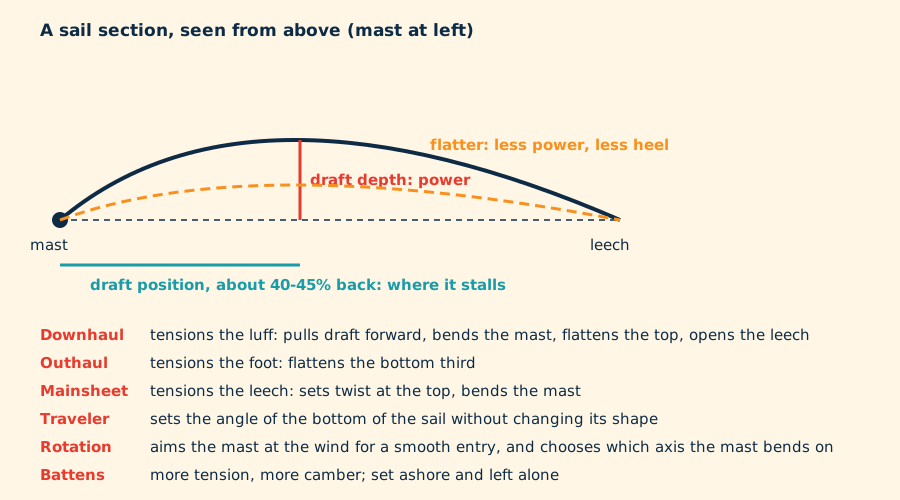
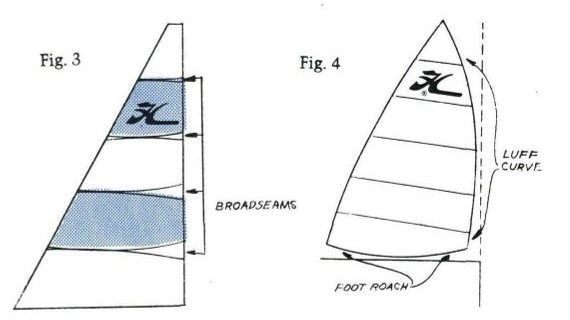
A sail's shape is sewn in two ways, by broadseaming the panels and by cutting a curve into the luff, and it is adjusted two ways, by stretching the cloth and by bending the mast to match or exceed the luff curve.1 Stretch the luff with the downhaul and the draft moves forward; stretch the foot with the outhaul and the bottom flattens; bend the mast and the luff curve is pulled straight, which flattens the whole sail and lets the leech fall off. The Hobie mast's teardrop section will not bend fore and aft under sail loads, so it bends on its narrow axis, and rotating the mast puts that axis in line with the load: "by allowing the mast more rotation this gives the flatter side of the extrusion a better fore and aft position and allows the mast to flex with increased tension on the main sheet, and in turn forming the mast to the luff curve of the sail, allowing the sail to become flatter."1 That sentence from 1973 is the whole theory behind mast rotation and the diamond-wire argument on the 18.
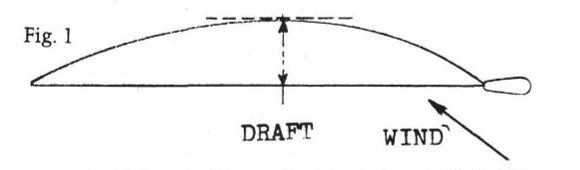
Where should the draft sit? About 40 to 45 percent back from the mast, closer to the mast as the sail tapers toward the top, and a little further aft in very light air, when the wind "does not have the power to bend around a full sail section, especially the forward part."813 Curry's optimum for the 14 is 45 percent aft with a depth of 16 percent of the chord.13 Schafer's experiment for finding out what your sail is really doing is still the best one: a row of telltales across each panel from mast to leech, then sail upwind watching the leeward side. On a 14 he found he was using about 30 percent of the sail; everything aft of the draft had separated.3
Downhaul
The downhaul (on other boats, the cunningham) is the most powerful string on a Hobie because the mast is unstayed above the hounds and the Comptip bends. Miller's 1993 column states the rule: "Generally, a downhaul should be tensioned just to remove the horizontal wrinkles from a sail. The harder you sheet the sail, the more downhaul (higher wind) that is needed. A downhaul will hold or even move the draft forward, to a point. When excessive downhaul is applied, the sail will become flat and the leech will become loose and twist away downwind in the upper panels, rendering the sail virtually powerless."11 Wick Smith counted three effects on the 17: it pulls the pocket forward against a wind that is trying to blow it aft, it pre-bends the mast, and the bend frees the leech. Try it on the beach: with no downhaul there is no bend; crank it and "the mast, especially the COMPTIP portion, is bent like crazy; all done with no mainsheet tension and no wind in the sail."9
How much, by wind. Hackney in 1978: sheet as if going to weather, then "pull the downhaul tight until the diagonal wrinkles have disappeared across the lower forward third of your sail. This is where it should be set for most sailing conditions. If the wind is really howling or extremely light, pull the downhaul so that the top of the gooseneck is even with the black band."2 Smith for the 17: under five knots, just the wrinkles out when the main is sheeted; five to fifteen, "a little beyond getting the wrinkles out to hold the pocket forward (not too much, though, or you will lose leech tension and pointing ability)"; above fifteen, increasing to maximum at twenty-plus. Downwind under fifteen knots, ease it slightly to move the pocket back and unbend the mast; above fifteen, "don't touch the downhaul. Lessening tension allows the top of the mast to fall away to leeward and destroys your boatspeed."9 Curry for the 14: "wrinkles out in all but very windy conditions. Pull the downhaul hard in windy conditions to bend the mast and release the leech."13 The 16 matrix below goes from wrinkles out to "hard" to "to the black band" as a crew moves from no trapeze to survival.17
The downhaul is also the gust control on the boats with enough purchase to pull it from the wire. The 20's stock 8:1 "allows the crew to limit heeling while sailing upwind in gusts and higher wind. During a gust, the crew will tension the downhaul, causing the upper panels to de-power and twist to leeward, spilling off the wind in the upper sections of the sail. The procedure enables the skipper to maintain sheet tension through the gust."11 Mark Santorelli, crewing for Wally Myers, never pulls more than four to eight inches of line in a gust, "which is 1/2-1 inch down the mast," and eases it back as the boat settles; the skipper steers straighter and feathers less.12 Curry's crews cleat everything else and play the downhaul.14
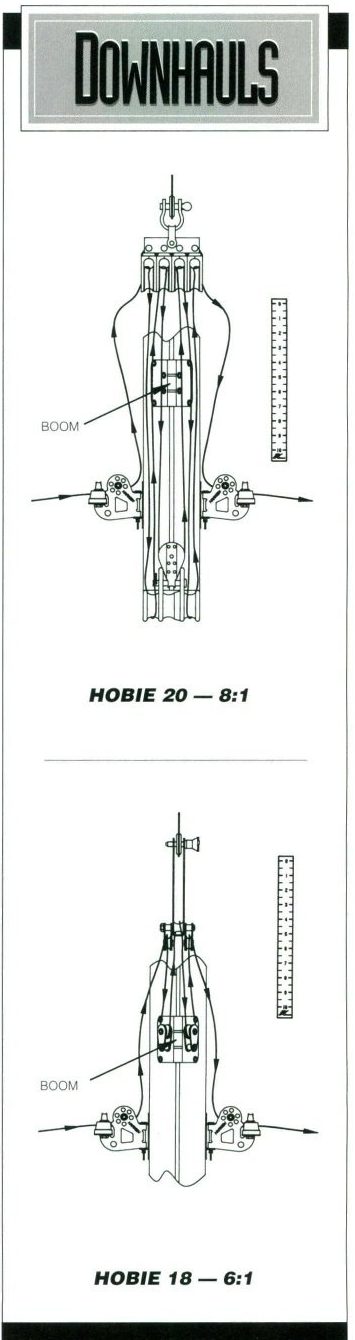
Three practicalities. First, downhaul and mainsheet work against each other at the gooseneck, so "it is best to apply tension to the downhaul, then sheet in on the sail until you can easily downhaul. Continue to sheet the sail harder while tensioning the downhaul, until the desired setting is achieved"; easing it means easing the sheet too.11 A gooseneck bearing (Hobie part 1511) takes the drag out of the slide on the 14 and 16.11 Second, on the 17 and any boat with a clew plate, release the outhaul before you put initial tension on the downhaul, or the mast-boom triangle can pull the clew plate out.9 Third, the black band. Until 2005 the 16 class rule put a band 24 feet 8 inches from the masthead and forbade downhauling the top of the gooseneck slide past it. The 2006 rules removed the limit, keeping the band only as a power-line warning label, and Miller, who thought the manufacturers would have kept it "due to the possible damage issues from over downhauling," still wrote: "Do not downhaul beyond these bands. Just take the wrinkles out!"1911 A racer who destroyed a new Dacron main at the 2014 North Americans by over-downhauling it with an 8:1 is the cautionary tale; a 16 with a 6:1 reaches the band easily, and an old sail will live at the band anyway.282
Set ashore. What the downhaul can do depends on how much the mast is allowed to bend: tight diamond wires on an 18 or 20 confine the bend to the tip, loose ones let the whole mast go, and rake sets how low the boom already is. See diamond wires in Rig Tuning.
Outhaul
The outhaul tensions the foot and so controls draft in the bottom third of the sail. Hackney set it with the mainsheet slack at "considerable" tension, 70 to 80 pounds, and as hard as possible in heavy and very light air, easing it only when wrinkles ran parallel to the boom and every time he turned downwind.2 On the 14, whose sail is not loose-footed, Curry simply cleats it as hard as he can "and forget it! Since it is not a loose-footed sail, the main does not benefit by releasing it."13 On the 18 it matters more, because the main is attached only at the track and clew: "On offwind legs, the outhaul should be eased as far as possible to gain additional power. When going upwind, it needs to come in tighter, but certainly not as tight as it can be set. In fact, if the outhaul is pulled too tight on the Hobie 18, a large and rather ugly wrinkle can appear in the bottom of the sail."4 Laurent's 18 scale: moderate in light air upwind, medium to firm in medium air, very hard in strong wind, completely loose downwind in all conditions, halfway between on other points of sail.6 Smyth on the 17 eased it to add two inches of camber along the foot for chop, five inches off the wind, and tightened it first when the breeze reached trapezing strength.7 Langford's beginner setting for the 16 is enough tension "to remove the wrinkles from the foot of the mainsail and create a soft fold, or shelf, in the bottom of the sail."8
Mainsheet and traveler
The mainsheet controls the leech, and through the leech, twist: the amount the top of the sail falls away to leeward relative to the bottom. Some twist is right, because the wind at the masthead is stronger and freer than the wind at the boom, so the top needs a wider angle; too much and the top does nothing. Schafer's two sins are oversheeting and undersheeting, and the first is the common one: "On upwind legs the tendency is to oversheet, using the mainsheet like a throttle... I've found that if I release a little tension, the leech frees up, the helm frees up and the boat picks up speed." His rule: "when in doubt, sheet out!"3 Berman's description of the two failure modes is the clearest: a leech that is too free loses its draft and lets the pocket move forward; a leech that is too tight "can overfill the after portion of a sail, making it difficult for the wind to flow off in a smooth and non-turbulent fashion."4 The forum's word for the second is a hooked leech, "like throwing up a parachute."22
The division of labor is simple. "In general, the mainsheet is controlling the top of the mainsail, and the traveller is controlling the lower part."20 The traveler changes the angle of the boom without changing the sail's shape, so it is the gross adjustment and the sheet the fine one. Bounds: "Always trim the main traveller first, then the sheet. The 16 likes to carry a lot of twist in the main, especially on a reach."29 Langford's way to find the base sheeting: stand five to ten feet behind the boat with the sheet in hand, pull until the leech lines up with the mast top to bottom, then ease until the top falls off a little; "this is twist."8 On the water the test is the upper leeward telltale: strap the main in until it stalls, then ease half an inch until it flows.7
Depowering upwind. Every published guide agrees on the order: traveler first, sheet tight. Laurent on the 18: "As the wind begins to increase to the point that you are becoming overpowered (i.e. flying a hull) you begin to move the main traveller out. This adjustment is very sensitive and in fact just 2-4 cms helps you to spill some excess power... But remember, in strong wind conditions, and when the main traveller is well out, you must sheet in the main sail very hard. This will give you an efficient, flat sail that will help you to perform well to windward."6 The 16 matrix starts depowering with the traveler down six inches and the main still two-blocked, because "initial de-powering uses the traveler rather than rake, so you can bring it back up if the wind drops," and the crew holds the traveler line and drops it a few inches as each puff arrives rather than easing the sheet, which fills the sail and moves the center of effort forward.17 Tom King's heavy-air version: "the main needs to be sheeted tight, and travel out as necessary to keep the boat on its feet. By 20 to 25, it's travelled all the way out, even upwind. Of course you aren't pointing as high, but boatspeed is up, and leeway is much less than trying to pinch to point."21 The practical obstacle on a 16 is that the 2:1 traveler will not move against a loaded 6:1 sheet, so either the crew works it or you set it before the puff; with a good crew the skipper has the sheet, the crew has the traveler, and "in a gust, you travel out, and in during a lull."21 The 20 is the exception: Curry keeps the traveler centered until "the boat gets too wild" and depowers with rotation and downhaul first.14
Reaching. Jerome Vaughan's beam-reach recipe for a 16 has been reposted for fifteen years: travel the jib out halfway, sheet it just enough to stop it flogging, travel the main out about a foot, ease the sheet a little, bear off until the boat goes, then sheet harder as it accelerates, because speed brings the apparent wind forward. "When you can't sheet anymore, try falling off to the point that you're just about to stall and see how long you can keep it in that groove." If the hull keeps popping before you can sail deep, travel out more so you can keep sheeting hard; ease the jib in heavy air because it pulls the bow down.20 A 17 skipper reads the bottom leeward telltale for the traveler and the top one for the sheet, "constantly adjust the traveller to keep the bottom leeward telltale just at the verge of stalling."7 Tie a knot in the traveler line so the car cannot leave the end of the track.6
Set ashore. How hard you can sheet is set by mast rake: the boom blocks must meet the traveler blocks just as the leech comes tight, which is the block-gap test. On a 16 the boom bail position decides how much the sheet also pushes the boom forward to rotate the mast; the forward bail pulls more down, the aft one more forward.22
Mast rotation
Rotation does two things. It aims the mast's leading edge at the apparent wind so the air flows smoothly onto the leeward side of the sail, and, because the mast is stiff fore-and-aft and bendy sideways, it chooses how much the mast bends under sheet and downhaul load. More rotation, more bend, flatter sail, more drag; less rotation, straighter mast, fuller sail.249
On the Hobie 16 there is nothing to adjust. The mast base has fixed stops, and "the mast should always be rotated against the stops going upwind - there's no intermediate setting on a Hobie 16." It swings stop to stop, from about eight o'clock to four o'clock with twelve at the bow, and sits against one stop or the other on every point of sail; a mast that will not reach its stop on one tack puts a visible dent in the entry and costs power on that tack.2223 The 1973 article allowed sailors to file the stops to let the mast over-rotate and bend in a breeze, and 14 racers still do, but on a 16 the mainsheet's forward pull on the boom already keeps the mast hard against its stop, and in light air that is what stops it slamming over every wave.122
The 14, 17, 18, 20 and 21 have a rotator arm under or above the boom with a line to a cleat; shorten the line to reduce rotation, let it out to increase it. The universal starting point is the arm pointed at the leeward shroud when sheeted in upwind. Smith's 17 settings refine it by wind: under five knots at the shroud or slightly forward, for a flat sail with an open leech; five to fifteen in flat water at the shroud or slightly aft, to close the leech for pointing; medium air with chop, less rotation, back as far as the centerboard line where it leaves the hull, to fill the sail; above fifteen, more rotation, and in "blowing like stink" conditions halfway between the shroud and the forward wing stanchion, which "really depowers the boat." If the fleet out-points you at equal speed, pull the rotator in an inch; if they point higher but slower, leave it and foot.9 Curry's 17 numbers are the same idea in degrees: at the daggerboard hole for pointing, 80 to 90 for reaches, 100 to 110 downwind.18 Berman on the 18 kept it between 30 and 70 degrees upwind and never under 40, more with light crew, flat water or heavy air, and 80 to 90 off the wind.4 Laurent's 18 fleet sailed the drifting Europeans with the arm at the sidestay and the windy Australian Worlds at 90 degrees, fully open, "the idea is to get the boat's power under control thereby allowing you to sail flat and fast."6 Curry's 20: to the shroud in light and medium air, to the outside of the rear beam upwind in a breeze and never past the inside hull sheer, because over-rotating lets the sail invert under maximum downhaul; a Hobie 20 fleet veteran calls reducing rotation "the best way to depower the H20 on the water."14
Downwind has one setting everywhere: as much as the mast will give, about 5 to 10 degrees past parallel with the front crossbar, "to get a good flow of air across the leeward side of the sail."9 Holding it there in light air is the trick. The class-legal fix is a non-adjustable line or bungee: Smith's is a 3/16 line between the two bow chainplates with a bungee and hook from its middle to the end of the rotator arm, which still lets the mast flip in a jibe and hooks to the dolphin striker when not in use; Smyth re-led the rotator line around the front of the mast into a positive system that held 100 degrees.97 And a safety: tie a figure-eight knot in the rotator line behind the cleat at the halfway-to-stanchion setting, so a slipped cleat cannot let the mast rotate further. "DO NOT ROTATE YOUR MAST ANY FURTHER FORWARD THAN THIS KNOT. IT CAN BREAK THE MAST OR THE GOOSENECK FITTING!"9 On the 21, positive rotation control is mandatory with a spinnaker and a counter-rotated mast after a tack has no warranty; see Rig Tuning.
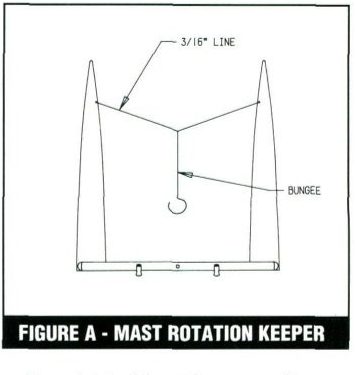
Set ashore. On the 18 and 20, diamond tension decides whether rotation bends the mast at all: tight wires reduce the effect of rotation on bend, loose wires make rotation the bending control. On the 16, a worn or mis-cut step stop sets the rotation permanently. See Rig Tuning.
The jib
The jib's job on a Hobie is to bend the air onto the main. Schafer carried the flattest jib he could, with untapered battens, so that it would "re-direct the flow of the air across the main with as little disturbance as possible," and tacked it as low on the bridle as he could to open the slot at the top.3 Mitch Booth's Tiger advice is the same: tack as low as possible, then choose the clew hole for a sheeting angle just over 45 degrees.15 Scott Ward's 16 setting was the second clew hole from the bottom to open the slot.5
Luff tension. On a 16 the jib halyard is both rig tension and jib luff tension, so it is the one rig setting you can work afloat: Langford snugs it until the shrouds tighten, tightens it a little as the wind picks up for more power, and warns that over-tightening stops the mast rotating and can make it counter-rotate.8 On the 18 the jib luff is a separate line at the tack, and Laurent's method is to sheet the main hard first, to preload the forestay, then pull the luff line "until an obvious fold extends fully up the luff of the jib and just behind the forestay," which gives an all-round setting; "a Hobie 18 will just not point when sailing to windward if the jib luff is allowed to sag loosely."6 Berman treats jib luff tension like the main's downhaul, tighter as the breeze builds to hold the draft forward, and since changing it means a crew on the bow, sets it for the forecast.4 Booth's Tiger rule: in strong wind remove the wrinkles and then a little more until the luff is flat and firm; in light wind "do not worry about having small wrinkles in the luff."15
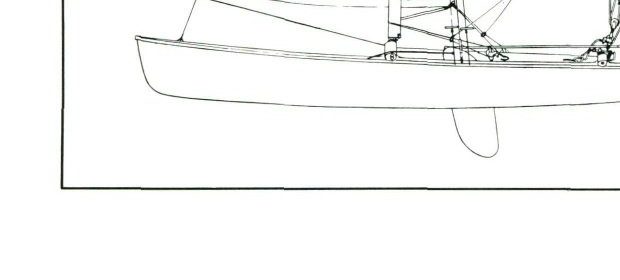
Leads, fore and aft. On the 18, 20 and Tiger the jib blocks ride in tracks. Moving them aft tensions the foot and frees the leech, flattening the bottom and twisting the top open; forward does the reverse. The setting method is universal: sheet in upwind, luff slowly, and watch which telltales break first. "If the top of the jib luffs first, then move the blocks forward. If the bottom of the jib luffs first, move the blocks back. The goal is to get the two sets of telltails to break evenly (or maybe just slightly earlier at the top)."25 Santorelli's mnemonic is "top/up, bottom/back."12 Then slide them aft as the wind builds to flatten the bottom and let the top twist, forward in chop or with a heavy crew for power, and all the way forward when tacking downwind.254 Most 18 racers set them for an even break upwind and leave them.25
Leads, in and out. The 16's jib traveler and the 18's and 20's inboard-outboard cars set the slot. The 16 matrix runs the jib car inboard until the boat is overpowered, then out two inches, three to four, six, and halfway in survival, opening more in waves, and notes that slightly too far out costs little.17 Curry's 20: the hiking strap in light air, all the way out in heavy; Laurent's 18: just outside the hiking strap in light air to fully out in a blow.146 Greg Thomas won two Hobie 20 nationals with the jib car locked at the halfway point of the daggerboard well and the block halfway between hiking strap and hull, and depowered in big wind not by traveling the jib out but by under-sheeting it: "when we are max downhaul and still looking to depower we then under sheet the jib but keep the main center travelled and sheeted in tight."25 Downwind in light and medium air the crew hand-holds the jib sheet out to the side from just behind the front crossbar, moving the arm up or down to keep the top flowing.2517
Set ashore. The tack hole on the bridle adjuster and the clew hole on the plate are chosen with the rake, because they set whether the jib blocks meet before the sheet is tight; see Rig Tuning, Hobie 16. On a 16, raise the tack and the sheet attachment must come down the clew plate, "but it's not hole-for-hole."
Battens
Battens are set before launch and are the least important control, which is why three generations of advice say the same thing. Bounds: "for most conditions, you pull the wrinkles out and just enough to make the batten 'stand up' - it will hold its shape under its own weight. For heavy air - over 15 kts consistently - just pull the wrinkles out... For lumpy water - crank the battens in, especially the top 3 battens." The vast majority of racers set a median shape and leave it, and "one blown tack far outweighs any gains by having the perfect sail shape."26 Schafer ran medium tension so he could add or subtract draft with the downhaul and outhaul, and liked Hobie Alter Jr.'s habit of sailing one set of battens all year and doing the adjusting on the water.3 Wick Smith's dissent is for chop: "When in doubt, use more tension. You have several controls to flatten the sail if necessary, but few will fill it out like batten tension."9
Curry tensions the 14's six battens from the bottom up with the sail on the trampoline: the bottom one almost standing, the next barely standing, the middle two standing, the top two barely and almost standing; the top three are tapered and soft so the draft stays forward as the sail narrows, and he sets the draft where a line from the aft end of the headboard to the middle of the boom crosses the sail.13 Tapering is class legal and nobody does it any more; on a 16 only the top two main battens are tapered, from the factory, and only Hobie battens are legal except on the F18 Tiger and Wild Cat and the 21.26 Jib battens on a 16 get the wrinkles out and a little more, with the stub taped so it does not catch the halyard; trim them so the cap barely clears the pocket.2627 Two checks with the boat tipped on its side on grass: sight down the leech for an even curve, and sheet hard to see the battens respond evenly without the leech hooking.5 And release the tension when the sail is put away: "Don't leave tension on the battens for more than a few days. You'll permanently deform the sail."26
Telltales
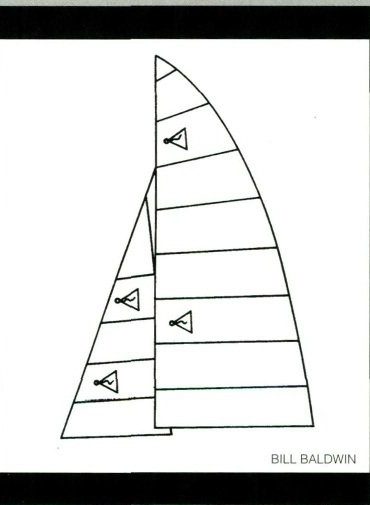
The Hotline's 1993 telltale article is the one to keep. Placement: a pair on each vertical third of the jib, nine to twelve inches behind the luff; on the main, a pair on the first panel above the hounds, where the air is clear of the jib, and another pair halfway down to the tack, both about twelve inches aft of the luff. "That's it for telltales on the sails. You need no more - these will do it all." If the windward telltale lifts, the sail is luffing: sheet in or bear away. If the leeward one lifts, the sail is stalling: ease or head up. Upwind, center the traveler and sheet the main until the upper leeward telltale stalls, ease until it flows, cleat; set the jib leads until the lower leeward telltale stalls, ease, set; sheet the jib until its upper leeward telltale stalls, ease, cleat. Downwind, with the apparent wind at 90 degrees on the bridle fly, bring the traveler in until the lower leeward main telltale stalls and ease; then the sheet for the upper one; then the jib the same way. Now all four pairs luff, stall and flow together, "like a barbershop quartet," and you steer to them, never stalling, luffing very little.10 Hobie's own sailing guide prints the same placement.16 Smyth put a third set on his 17 ten inches behind the mast, above and below the flying H, because the stock ones were too far aft to read the entry.7
Settings by wind
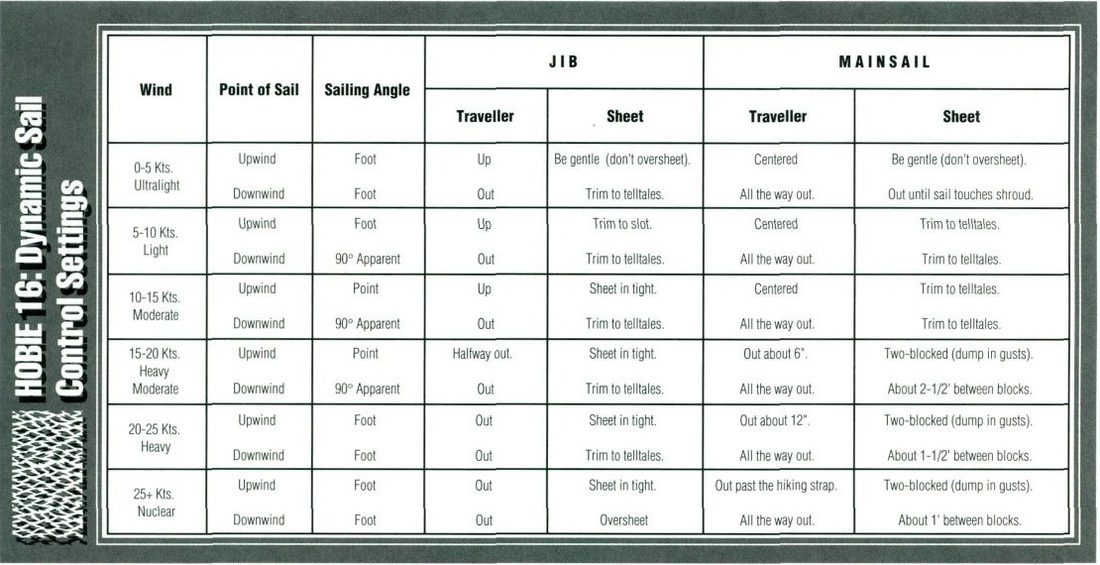
The most complete published set of Hobie 16 upwind settings is the matrix a championship crew posted after the 2003 Continentals, reproduced here with its reference points. "Rake back" means two inches more rake at the mast mark; it is a leeward-mark decision.17
| Condition | Mainsheet | Traveler | Downhaul | Jib sheet | Jib traveler | Rake |
|---|---|---|---|---|---|---|
| No trapeze | about 1 ft from two-blocked | centered | wrinkles out | open slot | inboard | base |
| Single trapeze | almost two-blocked | centered | wrinkles out | tight | inboard | base |
| Double trapeze | two-blocked | centered | a bit more | tight | inboard | base |
| Depower 1 | two-blocked | down 6 in. | more on | tight | out 2 in. | base |
| Depower 2 | two-blocked | down 6 in. | hard | tight | out 3-4 in. | back 2 in. |
| Depower 3 | two-blocked | down 12 in. | to the black band | easing | out 6 in. | back 2 more |
| Survival | two-blocked | at the leeward hiking strap | to the black band | eased | halfway out | back 2 more |
The other boats, in their champions' own numbers:
| Boat | Light | Medium | Heavy |
|---|---|---|---|
| Hobie 14 (Curry)13 | Traveler 5-6 in. off center upwind; downhaul wrinkles out; outhaul max; rig loose (120 degree twist) | Trapezing: traveler 3 in. out; rig 45 degree twist | Downhaul hard to bend the mast; reaches to the hiking strap, runs to the end of the track |
| Hobie 17 (Curry, Smyth, Smith)1879 | Traveler 2-3 in. off center; rotator at the shroud or slightly forward; downhaul with slight wrinkles; outhaul eased 2 in. in chop | Rotator at the shroud, aft to the centerboard line in chop; downhaul a little past wrinkles; outhaul tight | Traveler down 5-8 in.; rotator halfway to the wing stanchion; downhaul max; boards down, windward board up in marginal hull-flying |
| Hobie 18 (Laurent, Berman)64 | Traveler centered; rotator at the sidestay (never under 40 degrees); downhaul wrinkles out; outhaul moderate; jib car toward the middle of the track in chop | Traveler out 2-4 cm when overpowered; outhaul medium to firm; jib car aft for flat water | Traveler to the hiking strap, main sheeted very hard; rotation opened to 90 degrees; downhaul very hard; outhaul very hard |
| Hobie 20 (Curry)14 | Traveler centered; rotator at the shroud; jib leads in to the hiking strap; downhaul a few wrinkles; do not over-sheet, and if you must, the main not the jib | Rotator toward the aft end of the centerboard trunk at the top of moderate; jib leads halfway between strap and hull | Traveler centered until too wild; rotator to the outside of the rear beam; downhaul past the black band and eased 1 in. in lulls; jib leads all the way out; barberhaulers out |
Every one of these authors ends the same way Schafer did in 1980: go out with another boat, sail upwind side by side for three to five minutes, change one thing on one boat, and repeat. "You can't try these things while racing and hope to win."1